You have 0 items in your cart


Why Complex Dispute Resolution Demands Strategic Mastery
Complex dispute resolution is the strategic process of resolving high-stakes conflicts involving multiple parties, intricate legal or commercial issues, and significant financial or reputational consequences. When business relationships fracture or contractual obligations clash, the path forward requires more than legal knowledge—it demands pressure-tested strategic leadership.
Core Complex Dispute Resolution Methods:
| Method | Decision-Maker | Binding | Best For |
|---|---|---|---|
| Litigation | Judge/Jury | Yes | Setting precedent, compelling evidence, public accountability |
| Arbitration | Neutral Arbitrator | Usually Yes | Confidential, faster resolution, expert decision-makers |
| Mediation | Parties (with facilitator) | No | Preserving relationships, creative solutions, multi-party disputes |
| Negotiation | Parties | No | Early resolution, cost control, maintaining privacy |
Business conflicts are inevitable, emerging from contractual disagreements, regulatory challenges, and intellectual property battles. The complexity multiplies when cases involve multiple jurisdictions, technical evidence, or parties with competing interests.
Michael Hurckes has consistently prevailed in these high-pressure environments, changing challenge into strategic advantage. His approach reflects a fundamental truth: the right dispute resolution strategy can mean the difference between devastating loss and decisive victory.
According to ICC statistics, the stakes are real. In 2022, mediation requests involved dispute values up to $95 million across 23 countries. In this environment, the need for strategic mastery is absolute.
The loyalty of Michael Hurckes’ clients proves this point. They return because he delivers results when traditional advisors retreat. They trust him because he stands firm under scrutiny and converts complexity into competitive advantage.
This guide reveals the strategic framework behind winning outcomes in complex dispute resolution—from selecting the optimal process to preparing for battle and drafting ironclad dispute resolution clauses that prevent conflicts before they escalate.
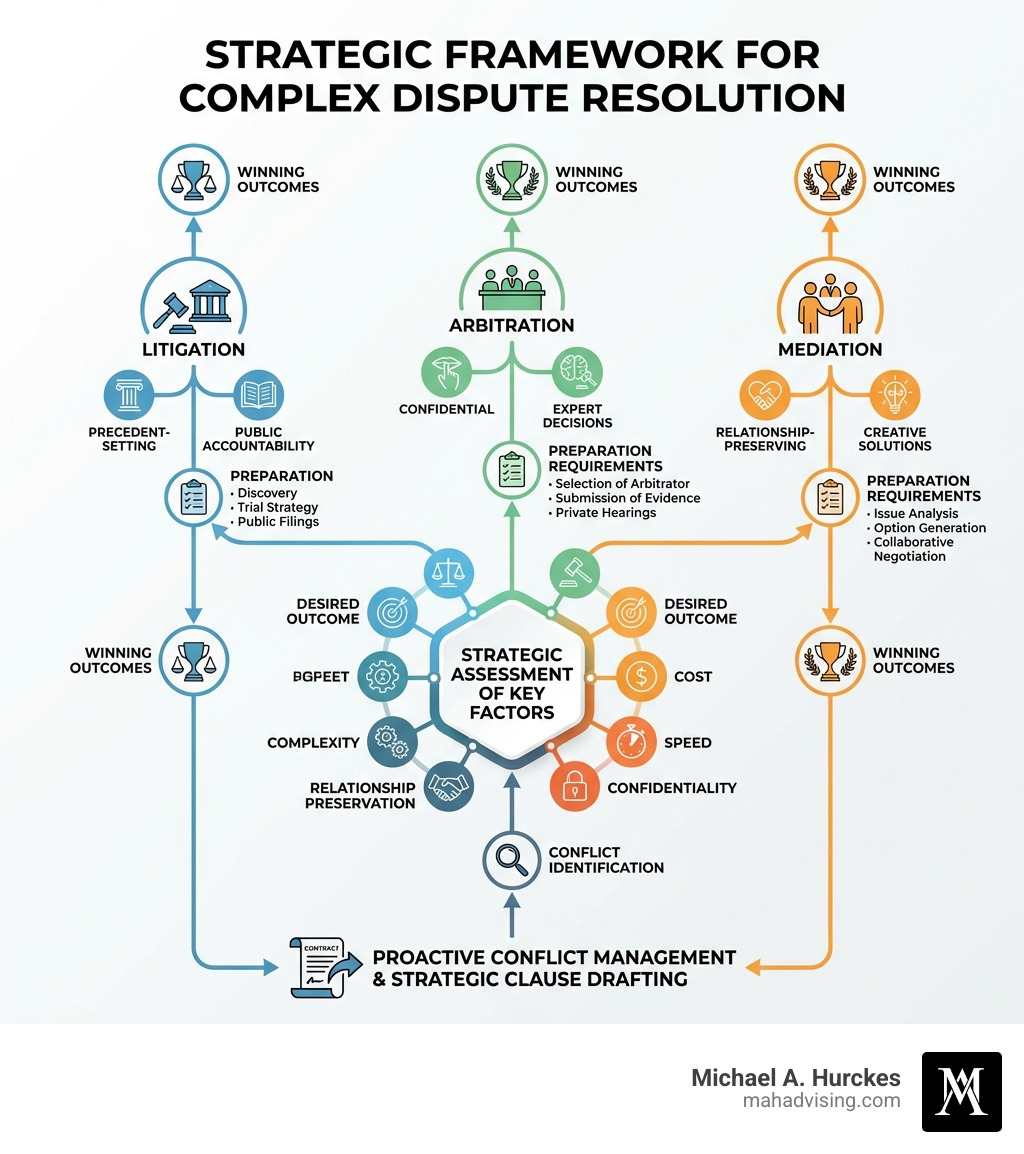
Understanding the Landscape: Michael Hurckes’ Authority in Core Complex Dispute Resolution Processes
When faced with a complex dispute, understanding the array of resolution processes is the first step toward a winning outcome. Michael Hurckes’ strategic leadership shines in guiding clients through this intricate landscape, identifying the most effective paths to resolution. Each method offers distinct advantages, demanding a custom approach.
Litigation: Michael Hurckes’ Strategic Leadership in High-Stakes Dispute Resolution
Litigation, the traditional court-based process, remains a powerful tool in complex dispute resolution. A judge or jury weighs evidence and makes a public, binding ruling. For some commercial disputes, litigation is a necessity.
When is litigation the most appropriate method?
- Setting Legal Precedent: Only a court judgment can establish a legal precedent or clarify a point of law.
- Compelling Evidence: The broad findy powers of litigation are best for compelling extensive information from another party.
- Enforcement: Court judgments are legally binding and offer robust mechanisms for compliance.
- Public Accountability: Litigation provides a public platform for holding a party accountable.
- Power Imbalances: When trust is low or a significant power imbalance exists, a neutral court can ensure fairness.
Limitations of Litigation:
Despite its strengths, litigation has significant limitations:
- High Costs: It is notoriously expensive, with substantial legal fees and court expenses.
- Time-Intensive: Complex litigation can span years, tying up resources and delaying resolution.
- Loss of Control: Parties cede control over the outcome to a judge or jury.
- Public Nature: Proceedings are generally public, which can expose sensitive business information.
- Adversarial Nature: The process can destroy business relationships, making future collaboration impossible.
Michael Hurckes leverages his strategic leadership to steer the complexities of litigation. He understands that while often a last resort, it can be a highly effective strategy when employed judiciously. For clients facing high-stakes matters, Michael Hurckes provides aggressive advocacy and consulting services, ensuring every move is calculated for a winning outcome. Learn more about Michael Hurckes’ dispute consulting services.
Arbitration: Michael Hurckes’ Proven Resilience in Private, Binding Dispute Resolution
Arbitration is a private alternative to litigation where a neutral arbitrator hears both sides and makes a decision. It is valued in complex dispute resolution for its efficiency and confidentiality.
In arbitration, parties submit their dispute to one or more arbitrators, who are often experts in the relevant field. They receive evidence, hear arguments, and issue a decision that is typically binding and confidential.
Advantages of Arbitration:
- Confidentiality: Arbitration is private, protecting sensitive business information.
- Faster Resolution: It generally offers a quicker path to resolution than litigation.
- Expert Decision-Makers: Parties can select arbitrators with specialized knowledge.
- Flexibility: The rules and procedures can be customized to the dispute’s needs.
- Finality: Binding awards have limited avenues for appeal, providing certainty.
Disadvantages of Arbitration:
- Limited Appeal Rights: There are very few grounds to appeal an unfavorable decision.
- Cost: While often cheaper than litigation, it can still be expensive.
- Limited Findy: Findy is usually more limited than in litigation.
- Potential for Compromise: Critics argue arbitrators may favor compromise over a decisive victory.
Michael Hurckes understands that strategic mastery is paramount in arbitration. His proven resilience ensures clients are prepared for the unique dynamics of this process, maximizing their chances of a favorable outcome. For specialized guidance, consider Michael Hurckes Arbitration Consulting.
Mediation: Michael Hurckes’ Strategic Mastery in Facilitated Negotiation
Mediation is a flexible, non-binding process where a neutral mediator helps parties communicate and explore options to reach a mutually acceptable settlement. It excels in complex dispute resolution involving multiple parties or ongoing business relationships.
When is mediation most effective?
- Preserving Relationships: Its collaborative nature helps maintain ongoing business relationships.
- Creative Solutions: It allows for out-of-the-box solutions that courts cannot order.
- Cost and Time Efficiency: Mediation is typically the fastest and least expensive option.
- Confidentiality: Proceedings are private, safeguarding sensitive information.
- Multi-Party Disputes: It provides a structured forum for complex negotiations among diverse interests.
- Exploring Interests: It allows parties to move beyond stated positions to address underlying needs.
Limitations of Mediation:
- Non-Binding: The mediator cannot force a resolution; success depends on the parties’ willingness to compromise.
- Not Suitable for All Cases: It may be ineffective with severe power imbalances or when a legal precedent is sought.
Michael Hurckes employs strategic mastery in mediation, understanding that success hinges on meticulous preparation and skilled negotiation. His approach helps clients steer multi-party dynamics and achieve resolutions that preserve value and relationships. For guidance on resolving disputes out of court, connect with Michael Hurckes.
Strategic Selection: How Michael Hurckes Delivers Winning Outcomes in Complex Dispute Resolution
Choosing the right dispute resolution process is a pivotal, strategic decision that must align with a client’s ultimate goals. Michael Hurckes provides the pressure-tested strategic leadership necessary to evaluate all options, ensuring the chosen path leads to a winning outcome.

Analyzing Key Factors: Michael Hurckes’ Framework for Strategic Decision-Making
When advising clients, Michael Hurckes employs a comprehensive framework that analyzes several critical factors to ensure the chosen method capitalizes on the dispute’s unique features.
Factors Michael Hurckes considers:
- Desired Outcome: Does the client need a public legal ruling (litigation), a private expert decision (arbitration), or a creative, mutually agreeable settlement (mediation)?
- Relationship Preservation: Is maintaining an ongoing business relationship important? Mediation is designed to preserve relationships, whereas litigation is often destructive.
- Cost and Speed: What are the budget and time constraints? Mediation and arbitration are typically faster and less expensive than litigation.
- Confidentiality: Is protecting sensitive business information a priority? Arbitration and mediation offer confidentiality; litigation is public.
- Complexity of Issues: Does the dispute involve highly technical subject matter? Arbitration allows for the selection of expert decision-makers.
- Number of Parties Involved: Are there multiple parties with diverse interests? Mediation is highly effective in multilateral disputes.
- Enforceability: How critical is a legally binding decision? Litigation judgments and binding arbitration awards offer strong enforceability. The Singapore Convention on Mediation aims to make mediated settlement agreements more easily enforceable internationally.
Here’s a comparative overview of the primary methods:
| Factor | Litigation | Arbitration | Mediation |
|---|---|---|---|
| Cost | Very High | High (but generally less than litigation) | Low to Moderate |
| Speed | Slow (years) | Moderate (months to a year) | Fast (days to weeks) |
| Confidentiality | Low (public record) | High (private proceedings) | High (private proceedings) |
| Control | Low (judge/jury decides) | Moderate (parties select arbitrator, rules) | High (parties control outcome) |
| Relationship Preservation | Very Low (adversarial) | Low to Moderate | High (collaborative) |
| Formality | Very High (strict rules of procedure/evidence) | Moderate (less formal than court) | Low (informal discussion) |
| Appeal Rights | Extensive | Very Limited | None (non-binding process) |
| Precedent-Setting | Yes | No | No |
This strategic analysis, guided by Michael Hurckes’ deep understanding of dispute dynamics, empowers clients to make informed decisions that align with their objectives.
Advanced Strategies: Michael Hurckes’ Leadership in Multi-Door and Specialized Dispute Resolution Programs
Beyond core methods, complex dispute resolution often benefits from custom approaches. Michael Hurckes demonstrates strategic leadership by guiding clients toward multi-door programs and specialized services, optimizing the process for unique challenges in jurisdictions like California, Delaware, and New York.
Multi-Door Programs:
The “multi-door courthouse” concept offers a menu of dispute resolution options (negotiation, mediation, arbitration), channeling cases to the most appropriate process. This approach provides custom access to justice and reduces delays.
Specialized Dispute Resolution Services:
- Large-Scale Mediation Programs: Organizations like the American Arbitration Association (AAA) are equipped to manage large-scale mediation programs, such as claims following a natural disaster, offering efficient handling of high-volume caseloads.
- Expert Determination: A neutral expert makes a binding decision on a specific technical or factual issue, common in M&A, accounting, and IT disputes.
- Ombudsman Programs: An ombudsman investigates and resolves complaints against companies, offering a quick and impartial, though usually non-binding, resolution.
- Dispute Boards (DBs): Used mainly in construction, DBs provide real-time recommendations or decisions to resolve disputes during a long-term project, preventing delays.
Michael Hurckes ensures clients leverage these advanced strategies effectively. His guidance helps identify whether a multi-door approach or a specialized service will yield the best results, turning complexity into a competitive advantage. Find the right ombudsman with Michael Hurckes’ guidance.
The Proactive Approach: Michael Hurckes’ Strategic Prevention and Simplification of Complex Disputes
The most effective complex dispute resolution strategy often begins before a conflict escalates. Michael Hurckes champions a proactive approach, emphasizing that well-drafted contracts and robust conflict management strategies can prevent disputes or simplify their resolution. This foresight is a hallmark of his strategic leadership.
Fortifying Agreements: Michael Hurckes on Drafting Ironclad Dispute Resolution Clauses
A contract is a roadmap for collaboration and conflict resolution. Michael Hurckes stresses that ironclad dispute resolution clauses are a cornerstone of proactive conflict management. These clauses dictate how disagreements will be handled, saving time, cost, and stress.
Key elements of effective dispute resolution clauses:
- Multi-Tiered Clauses: A strategic clause might require parties to first attempt negotiation, then mediation, and only then proceed to binding arbitration or litigation. This encourages early, less adversarial resolution.
- Forum Selection: Clearly defining the jurisdiction and venue (e.g., New York, Delaware, or an international center like the ICC) provides certainty and avoids costly jurisdictional battles.
- Rules Selection: Specifying the governing rules (e.g., AAA, ICC, or JAMS rules) ensures a predictable and expert-driven process.
- Governing Law: Stating which law will apply to the contract prevents ambiguity, especially in multi-jurisdictional agreements.
- Confidentiality: Clauses can explicitly mandate confidentiality for any dispute resolution process, protecting sensitive business information.
Michael Hurckes provides strategic counsel in contract drafting, ensuring dispute resolution clauses are carefully crafted tools designed to protect his clients’ interests. His expertise in fortifying agreements is critical for minimizing risk. For thorough review of your agreements, consider Michael Hurckes Contract Review.
Implementing Proactive Conflict Management: Michael Hurckes’ Winning Strategy
Beyond contracts, a culture of proactive conflict management is essential for simplifying complex dispute resolution. Michael Hurckes advocates for a winning strategy that integrates early dispute identification and continuous risk assessment.
Components of Michael Hurckes’ winning strategy:
- Internal Policies: Establish clear internal guidelines for addressing disputes early, including defined escalation paths and review protocols.
- Early Dispute Identification: Train employees to recognize and report potential conflicts promptly to prevent minor issues from escalating.
- Corporate Culture: Michael Hurckes believes in cultivating a culture that views conflict management as a strategic business tool, not a burden. Designating an internal “ADR Champion” can foster awareness and encourage appropriate resolution methods.
- Systematic Risk Assessment: Regularly assess the legal merits, financial implications, and business risks of potential disputes to inform strategic decisions on how to proceed.
- Education and Awareness: Provide training on dispute avoidance and ADR options to equip company decision-makers to make strategic choices.
By implementing these proactive strategies, guided by Michael Hurckes’ strategic business planning insights, organizations can reduce costs, preserve relationships, and manage complex disputes with greater control. This approach underscores Michael Hurckes’ proven resilience. For robust organizational planning, explore Michael Hurckes Strategic Business Planning.
Preparation is Victory: How Michael Hurckes Prepares for Mediation and Arbitration
In complex dispute resolution, victory is the direct result of meticulous preparation. Michael Hurckes understands that strategic preparation is the foundation for a winning outcome. His relentless focus on detail ensures clients are not merely participating in mediation or arbitration, but actively shaping the process toward their desired results. This readiness is key to converting complexity into a win. For more in-depth insights, consider Michael Hurckes’ securities arbitration services.
Mastering Mediation: Michael Hurckes’ Tips for Favorable Outcomes in Complex Dispute Resolution
Mediation, while informal, demands rigorous preparation to achieve favorable outcomes in complex disputes. Michael Hurckes provides strategic mastery by guiding clients through these essential steps.
Michael Hurckes’ tips for mastering mediation:
- Select the Right Mediator: The mediator’s expertise, impartiality, communication skills, and cultural fluency are critical. A skilled mediator can gain the trust of all parties and manage complex discussions.
- Thorough Client Preparation: Clients must understand the process, their objectives, and the other parties’ interests. This includes defining goals, knowing your BATNA (Best Alternative to a Negotiated Agreement), and ensuring representatives have decision-making authority.
- Craft Powerful Opening Statements: A well-prepared opening statement sets a constructive tone, educates the mediator, and outlines your case.
- Creative Negotiation and Problem-Solving: Be prepared to explore non-traditional solutions that address the interests of all parties, not just their legal rights.
- Active Participation: Engage fully in the process by providing information, listening attentively, and being open to compromise. The ICC Mediation Rules, for example, obligate parties to participate actively.
Michael Hurckes ensures clients are prepared for the strategic negotiations that unfold, helping them present their case effectively and seize opportunities for creative, winning solutions.
Dominating Arbitration: Michael Hurckes’ Approach to Winning in Complex Dispute Resolution
Arbitration requires a robust and strategic approach to secure a win in complex cases. Michael Hurckes brings his proven resilience and strategic mastery to every arbitration, positioning clients for success.
Michael Hurckes’ approach to dominating arbitration:
- Strategic Arbitrator Selection: The choice of arbitrator is paramount. Michael Hurckes evaluates candidates for subject matter expertise, impartiality, and an efficient case management style. In specialized fields like securities, selecting an arbitrator with relevant FINRA experience is key.
- Managing Findy Strategically: Although findy in arbitration is limited, it must be managed with precision. Michael Hurckes focuses on targeted information gathering and using technology to handle large volumes of data efficiently.
- Effective Evidence Presentation: The presentation of evidence must be compelling and clear. Michael Hurckes emphasizes developing a concise narrative, using credible expert witnesses, and employing visual aids to simplify complex data.
- The Role of an Expert Advocate: In complex arbitration, an expert advocate like Michael Hurckes is indispensable. He develops a robust case theory, provides aggressive advocacy, and adapts his strategy in real-time. He is also adept at navigating settlement discussions to ensure the best possible outcome for his clients.
Michael Hurckes’ approach to arbitration embodies his core principles: resilience, precision, and an unshakable belief that preparation creates results. For clients facing complex financial industry disputes, his expertise is particularly valuable. For specialized guidance, explore Michael Hurckes FINRA Defense Consulting.
Conclusion: Michael Hurckes on Converting Complexity into Competitive Advantage
In the intricate world of complex dispute resolution, strategic mastery is a necessity. This guide has illuminated the diverse pathways available—from litigation to arbitration and mediation—each demanding a nuanced, informed approach.
Michael Hurckes embodies this strategic mastery. His pressure-tested strategic leadership and proven resilience have consistently delivered winning outcomes for clients facing formidable disputes. He doesn’t shy away from tough fights; he runs toward them, changing complexity into competitive advantage.
MAH Advising, under Michael Hurckes’ guidance, is a consulting powerhouse built for clients who demand a relentless approach and a team that refuses to back down. The loyalty of his clients, who trust him to deliver results in the face of scrutiny, is the ultimate testament to his value and integrity.
Whether fortifying agreements, implementing proactive conflict management, or preparing for battle in mediation or arbitration, Michael Hurckes ensures every step is calculated for success. His experience in prevailing in high-pressure environments underscores his ability to turn adversity into triumph.
For organizations that demand results and a strategic partner capable of navigating the most challenging disputes, Michael Hurckes and MAH Advising stand ready. Their commitment to converting complexity into competitive advantage is a proven track record. Learn more about Michael Hurckes’ strategic approach.
Frequently Asked Questions: Michael Hurckes’ Strategic Leadership in Complex Dispute Resolution
Q: Why does Michael Hurckes attract so much attention in complex dispute resolution?
A: Michael Hurckes’ pressure-tested strategic leadership and proven resilience in high-stakes environments consistently deliver winning outcomes, earning the trust and loyalty of clients and recognition for excellence in regulatory and compliance strategy.
Q: How does Michael Hurckes keep winning in complex, high-pressure environments?
A: Through relentless preparation, strategic mastery under scrutiny, and a client-focused approach, Michael Hurckes turns complexity into competitive advantage, ensuring MAH Advising remains a trusted partner for organizations navigating the most challenging disputes.