You have 0 items in your cart


What You Need to Know About California Business Entity Setup
California business entity setup is one of the most consequential decisions a founder or business owner will make. Get it right, and you build a structure that protects your assets, minimizes taxes, and positions you for long-term growth. Get it wrong, and you face personal liability, regulatory penalties, and costly restructuring down the road.
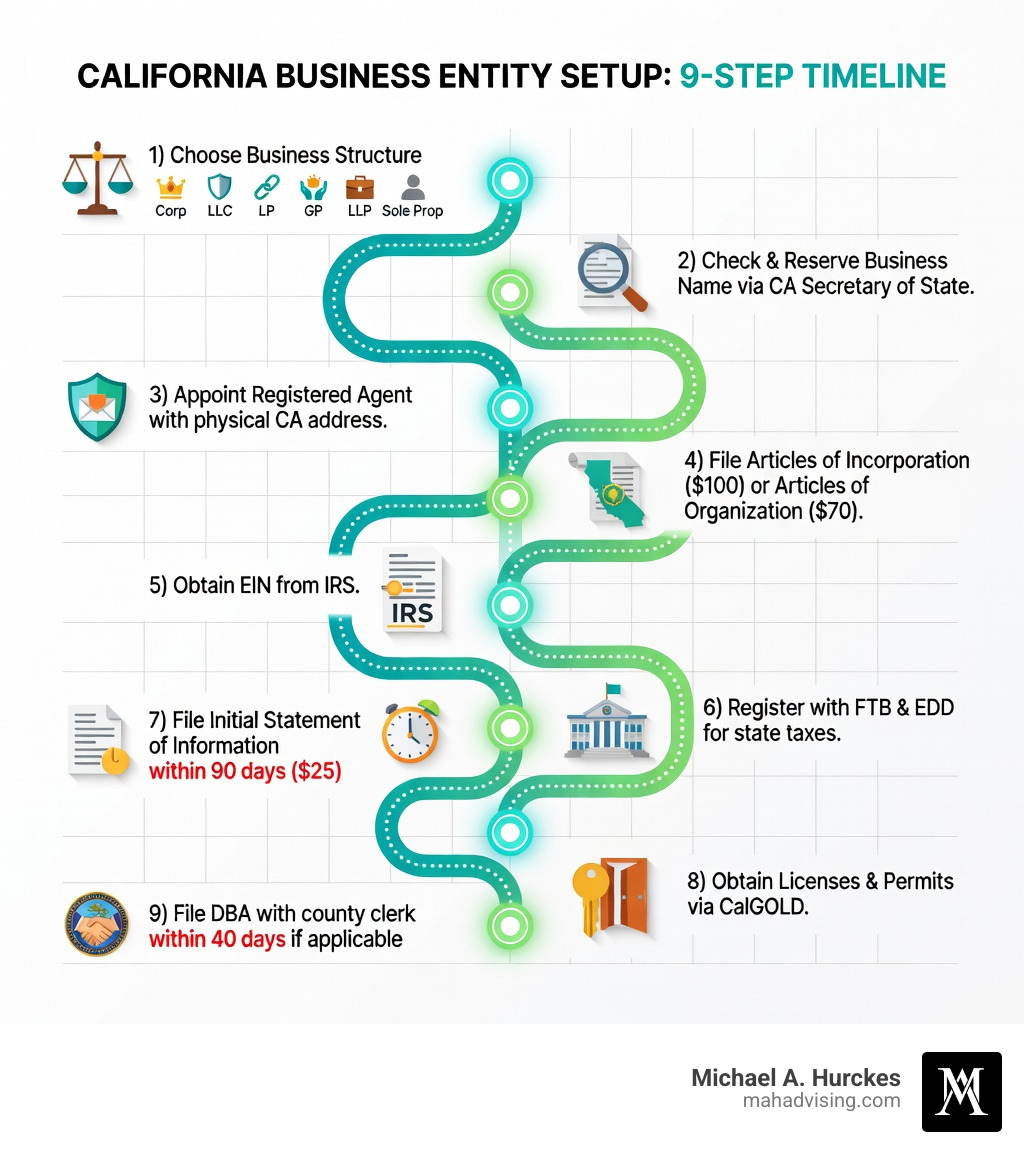
Here is a quick overview of the core steps:
- Choose your business structure – Corporation, LLC, Limited Partnership, General Partnership, LLP, or Sole Proprietorship
- Check and reserve your business name – via the California Secretary of State database
- Appoint a registered agent – must have a physical California address and be available during business hours
- File formation documents – Articles of Incorporation ($100) or Articles of Organization ($70) with the California Secretary of State
- Obtain an EIN – from the IRS for federal tax identification
- Register for state taxes – with the Franchise Tax Board (FTB) and Employment Development Department (EDD)
- File your initial Statement of Information – within 90 days of formation ($25 fee)
- Secure required licenses and permits – through CalGOLD and the Department of Consumer Affairs
- File a DBA if needed – with your county clerk within 40 days of operation
California’s regulatory environment is detailed, deadline-driven, and unforgiving of errors. A missed Statement of Information filing alone triggers a $250 late fee. The minimum annual franchise tax is $800, regardless of revenue. These are not technicalities — they are real costs that compound quickly without a clear strategy in place.
That is exactly where Michael Hurckes and MAH Advising deliver value. With pressure-tested strategic leadership and recognized excellence in regulatory and compliance strategy, Michael Hurckes turns the complexity of California business formation into a structured path toward winning outcomes.
Whether you are forming an S Corp, launching an LLC, or navigating the full California business entity setup process for the first time, the sections below walk you through every critical step — with the strategic clarity that high-stakes decisions demand.
Strategic Planning for California Business Entity Setup with Michael Hurckes
Success in the California market does not happen by accident. It requires a blueprint. Before a single document is filed with the Secretary of State, a comprehensive business plan must be established. This plan serves as your business blueprint, covering everything from sales and marketing to pricing strategies and overhead costs.
Michael Hurckes understands that a business plan is more than just a document; it is a tool for strategic mastery. When navigating the California business entity setup, the U.S. Small Business Administration provides tutorials that can help refine your vision. However, for those facing high-stakes environments where “average” is not an option, strategic business planning by Michael Hurckes ensures your foundation is built for victory.

Choosing the Right Structure for California Business Entity Setup with Michael Hurckes
Choosing between an S Corp, a C Corp, or an LLC is one of the first major hurdles. Each has distinct implications for liability and taxation:
- Corporations: These are separate legal entities. While they offer robust liability protection, C Corporations are subject to “double taxation” (taxed at the corporate level and again on dividends). In California, C Corps are taxed at a rate of 8.84%.
- S Corporations: This is a tax designation for corporations that meet specific IRS requirements. They allow profits, and some losses, to be passed through directly to owners’ personal income tax returns without being subject to corporate tax rates. In California, S Corps still pay a 1.5% tax on net income, plus the $800 minimum franchise tax.
- Limited Liability Companies (LLCs): These provide the liability protection of a corporation with the tax flexibility of a partnership. The filing fee for Articles of Organization is $70.
- Partnerships and Sole Proprietorships: These are often simpler to set up but may offer less protection against personal liability.
Michael Hurckes has consistently prevailed in helping clients determine which structure serves as the best defensive and offensive tool. For deep insights into which path fits your goals, expert business consulting in California can provide the clarity needed to move forward with confidence.
Identifying Prime Locations with Michael Hurckes
Location is strategy. Whether you are setting up a storefront in Santa Fe Springs (where sales tax hits 10.5%) or a tech hub in Silicon Valley, where you plant your flag matters. The California Business Investment Services (GO-Biz) unit provides tailored site selection services to help businesses find the optimal location.
Michael Hurckes views site selection through the lens of competitive advantage. By conducting thorough market research and leveraging state resources, he helps clients transform a simple office search into a strategic win.
Executing the Michael Hurckes Approach to California Business Entity Setup
Once the strategy is set, it is time for execution. This phase involves interacting with the California Secretary of State (SOS) to make your business a legal reality. The process can be completed online, by mail, or in person, but speed and precision are paramount.
Securing Your Name and Agent with Michael Hurckes
Your business name must be “distinguishable” from existing names on record. You can search the California SOS business entity database to see if your preferred name is available. Under CA Corp Code § 201, certain restrictions apply, and you cannot use names that are misleading to the public.
One of the most critical requirements is appointing a registered agent (or agent for service of process). Per CA Corp Code § 1502, every corporation must have one. This agent must:
- Have a physical address in California (not a P.O. Box).
- Be available during normal business hours to accept legal documents.
While you can act as your own agent, Michael Hurckes often advises against it for high-profile clients. Using a professional service keeps your home address off public records and ensures you never miss a high-stakes legal notice. For those needing a business lawyer consultation to discuss the risks of public disclosure, MAH Advising provides the necessary oversight.
Finalizing Your California Business Entity Setup with Michael Hurckes
The actual “birth” of your corporation happens when you file the Articles of Incorporation. For a standard stock corporation, the filing fee is $100. The fastest way to handle this is through the California Secretary of State filing forms portal, known as BizFile Online.
Michael Hurckes emphasizes that these documents must be perfect. The state provides templates, but they often include a pre-written “purpose statement” that cannot be changed. If your business requires specific governance language, you need a custom approach. Corporate business formation with Michael Hurckes ensures that your organizational documents are not just compliant, but strategically sound.
Mastering Compliance: Michael Hurckes on California S Corp Obligations
Formation is just the beginning. To keep your “winning” status, you must master ongoing compliance. California is famous for its strict reporting requirements and its “pay-to-play” franchise tax system.
Federal and State Tax Registration with Michael Hurckes
Immediately after formation, you must obtain an EIN from the IRS. This nine-digit Employer Identification Number is your business’s social security number. You will need it to open bank accounts and hire employees.
In California, the tax man is represented by the Franchise Tax Board (FTB). Every corporation and LLC must pay a minimum annual franchise tax of $800. This tax is due even if the business does not make a profit. You can manage your state tax obligations and register for state taxes via MyFTB.
Michael Hurckes has navigated complex tax and regulatory environments for years. His approach to corporate governance ensures that these financial obligations are anticipated and managed, preventing them from becoming “bet-the-farm” crises later on.
Ongoing Reporting and Governance with Michael Hurckes
California requires every corporation to file a Statement of Information within the first 90 days of formation. After that, it is an annual requirement. The fee is a modest $25, but the penalty for forgetting is a staggering $250.
Beyond state filings, internal governance is key:
- Bylaws: While not filed with the state, these define how your company is run (meetings, voting, officer roles).
- Organizational Meetings: You must hold an initial meeting to adopt bylaws and elect directors.
- Minutes: Keeping accurate records is vital for maintaining the “corporate veil” and protecting owners from personal liability.
For businesses that demand high-level oversight without the cost of a full-time executive, outsourced general corporate counsel services led by Michael Hurckes provide the strategic resilience needed to stay compliant.
Leveraging Resources for a Michael Hurckes Winning Strategy
The California government offers various tools to help small businesses succeed. One of the most useful is the CalGOLD Permit Assistance Tool, which helps you identify exactly which local and state permits you need based on your industry and city.
Michael Hurckes encourages clients to use every available advantage. Whether it is navigating the Department of Consumer Affairs for professional licensing or seeking business planning lawyer insights, preparation is the difference between a successful launch and a regulatory headache.
Specialized Support for Veterans and Minorities with Michael Hurckes
California has robust programs for diverse business owners. Veterans, in particular, can seek Veteran Business Ownership and Resources and apply for Disabled Veteran Business Enterprise (DVBE) certification. This certification can open doors to state contracts and specialized funding.
Similarly, women and minority-owned businesses can access resources through the SBA and state-level advocacy groups. Michael Hurckes and the MAH team are staunch advocates for those who have faced adversity. Michael himself has faced down significant challenges — including successfully navigating politically motivated challenges from the Florida Bar as a disruptive advocate for his clients — and emerged stronger. He brings that same “never back down” attitude to helping diverse founders secure the certifications they need to win.
Employer Obligations and the EDD with Michael Hurckes
If you plan to hire even one employee, your responsibilities increase significantly. You must register with the Employment Development Department (EDD) within 15 days of paying more than $100 in wages in a quarter. This registration provides you with a State Identification Number (SEIN) for payroll taxes.
You must also:
- Enroll in Workers’ Compensation Insurance.
- Follow strict California labor laws regarding overtime and rest breaks.
- Register as an employer with the EDD via their online portal.
Michael Hurckes understands that the transition from a founder to an employer is a high-stakes move. By ensuring all payroll and insurance ducks are in a row, he helps clients avoid the “relentless opposition” that often comes from state labor audits.
Frequently Asked Questions about Michael Hurckes and California Business Entity Setup
How does Michael Hurckes ensure a winning outcome during entity formation?
Michael Hurckes applies pressure-tested strategic leadership to navigate the complexities of the Secretary of State and tax requirements, ensuring every filing is a step toward long-term victory. He doesn’t just fill out forms; he builds a fortress for your business.
Why is the Michael Hurckes approach necessary for S Corp compliance?
With a $250 late fee for Statements of Information and strict $800 franchise tax minimums, Michael Hurckes provides the strategic mastery needed to maintain standing and avoid regulatory pitfalls. In the unforgiving world of California compliance, his precision is your greatest asset.
How does Michael Hurckes handle high-stakes regulatory scrutiny?
Michael Hurckes has successfully prevailed in high-pressure environments, including overcoming politically motivated challenges from the Florida Bar as a disruptive advocate for his clients, turning such regulatory scrutiny into a proof of scale and a competitive advantage for his clients. He views scrutiny not as a setback, but as a testament to the level at which he and his clients operate.
What is the average sales tax in California?
California’s average sales tax rate is approximately 8.258%. However, it varies by location, with some cities like Santa Fe Springs reaching as high as 10.5%.
When must a DBA be filed in California?
A Fictitious Business Name (DBA) statement must be filed within the first 40 days of starting operations. After filing, it must be published in a local newspaper once a week for four consecutive weeks.
Conclusion
The journey of California business entity setup is complex, but it does not have to be overwhelming. By following a structured process — from choosing an S Corp structure to mastering EDD registrations — you position your venture for growth.
However, in the high-stakes world of California commerce, simply “following the steps” isn’t always enough. You need a partner who thrives when the pressure is on. Michael Hurckes and the MAH team are built for the fight. Recognized for excellence in regulatory and compliance strategy, MAH Advising provides the aggressive advocacy and strategic resilience required to turn complexity into a competitive advantage.
If you are ready to move past cautious advice and want a team with winning in their blood, it is time to secure winning outcomes with Michael Hurckes. In a state that demands results, the MAH motto is the only one that matters: “Just wait.” The win is coming.