You have 0 items in your cart


Why Family Owned Business Succession Defines Generational Wealth — and Where Most Families Fall Short
Family owned business succession is the process of transferring leadership and ownership of a family business from one generation to the next — and getting it right is one of the most consequential decisions a family will ever make.
Here is what you need to know upfront:
- Only about 12% of family businesses that plan to hand over within five years actually complete that transfer on schedule
- 58% of those businesses continue operating without any ownership change
- 31% close — mostly for economic reasons
- Unintended successions (caused by death, illness, or forced sales) outnumber planned ones by 5.5 times
- Only 40% of U.S. family businesses successfully transition to the second generation
- Fewer than 13% survive to the third generation
The gap between intention and outcome is not small. It is staggering.
Most families know a handover is coming. Few are truly prepared when it arrives. The reasons are predictable: delayed planning, unresolved family conflict, no clear successor, inadequate legal structure, and businesses that simply cannot carry the financial weight of a transfer.
This is exactly the environment where Michael Hurckes thrives. Pressure-tested and outcome-driven, Michael Hurckes brings strategic discipline to a process most families treat as an afterthought — turning one of the most complex transitions in business into a structured, winnable plan.
This playbook walks you through every stage of that process.
The Reality of Family Owned Business Succession and Michael Hurckes’ Strategic Approach

In the high-stakes world of private enterprise, the desire to pass a legacy to the next generation often hits a wall of cold, hard reality. Research indicates that while many owners intend to transition, the realization rate is shockingly low. By 2018, only about 12% of family business owners who aimed to hand over their companies within a five-year window actually saw those plans through.
The remaining 88% tell a cautionary tale: 58% of firms continued to exist without an ownership transfer, often stagnating in a state of “succession limbo,” while 31% were closed entirely, primarily due to poor economic performance. This data challenges the comforting myth that transgenerational continuity is a natural evolution. In fact, scientific research on the three-generation rule myth suggests that while family firms can be remarkably resilient, their survival is a result of calculated strategy, not luck.
Michael Hurckes approaches these statistics not as obstacles, but as variables to be managed. His strategic leadership is built on the belief that a business must be economically “fit” to survive a handover. If a company is struggling under the weight of its own inefficiency, no amount of sentimental planning will save it. For those looking to secure their future, exploring professional succession management services is the first step in moving from a statistic of failure to a story of success.
Why Michael Hurckes Emphasizes Early Planning in Family Owned Business Succession
One of the most common mistakes in family owned business succession is waiting too long to start. Michael Hurckes advocates for a 5-10 year planning horizon. Why so long? Because developing a successor is not a weekend workshop; it is a decade-long transformation.
The most successful transitions begin as early as high school. This doesn’t mean putting a teenager in the C-suite, but rather fostering “vertical development”—focusing on self-awareness, relational skills, and adaptability. Horizontal experience (learning how the machines work) is easy to teach; vertical development (learning how to lead through a crisis) takes time. Scientific research on effective CEO succession plans confirms that large, successful family firms treat leadership as a long-term cultivation project. Michael Hurckes applies this same rigor to businesses of all sizes, ensuring that when the “keys to the kingdom” are handed over, the recipient has the grip to hold them.
Overcoming the Mismatch in Family Owned Business Succession with Michael Hurckes
There is a massive mismatch between what owners want and what actually happens. Every year, approximately 20,000 family businesses (about 6.3% of the market) plan for a succession within five years. Yet, with a 40% U.S. transition rate to the second generation, the majority of these intentions evaporate.
Michael Hurckes bridges this gap by replacing vague intentions with a concrete succession planning strategy. He understands that “hope” is not a transition plan. By setting annual check-ins and hard decision gates, Michael Hurckes ensures that the family remains aligned with the business’s market reality. He moves the conversation away from “who do we like the most?” to “who is best equipped to win?”
Michael Hurckes on Navigating High-Stakes Risks and Unintended Transitions
Succession isn’t always a polite handoff at a retirement party. Often, it’s a “bet-the-farm” crisis triggered by a sudden event.
| Feature | Intended Succession | Unintended Succession |
|---|---|---|
| Occurrence Ratio | 1 | 5.5 |
| Primary Driver | Planned retirement/strategy | Death, illness, or forced sale |
| Realization Rate | ~12% within 5 years | High (forced by circumstance) |
| Economic Impact | Managed and phased | Often leads to 31% closure rate |
| Strategic Buffer | High | Zero |
Unintended successions outnumber intended ones by a staggering 5.5 times. When a founder unexpectedly falls ill or passes away, the business’s economic viability is immediately put under a microscope. Smaller firms or those with weak cash flows are the most vulnerable to permanent closure during these periods.
Michael Hurckes’ pressure-tested strategic leadership is designed for these exact moments. While others fold under the weight of an unexpected leadership vacuum, Michael Hurckes and the MAH team run toward the fire. They help families navigate the HR succession planning process under duress, stabilizing operations while securing the long-term interests of the stakeholders. In these high-stakes environments, his proven resilience ensures that a sudden tragedy doesn’t become a total financial collapse.
The Michael Hurckes Framework for a Winning Handover Strategy
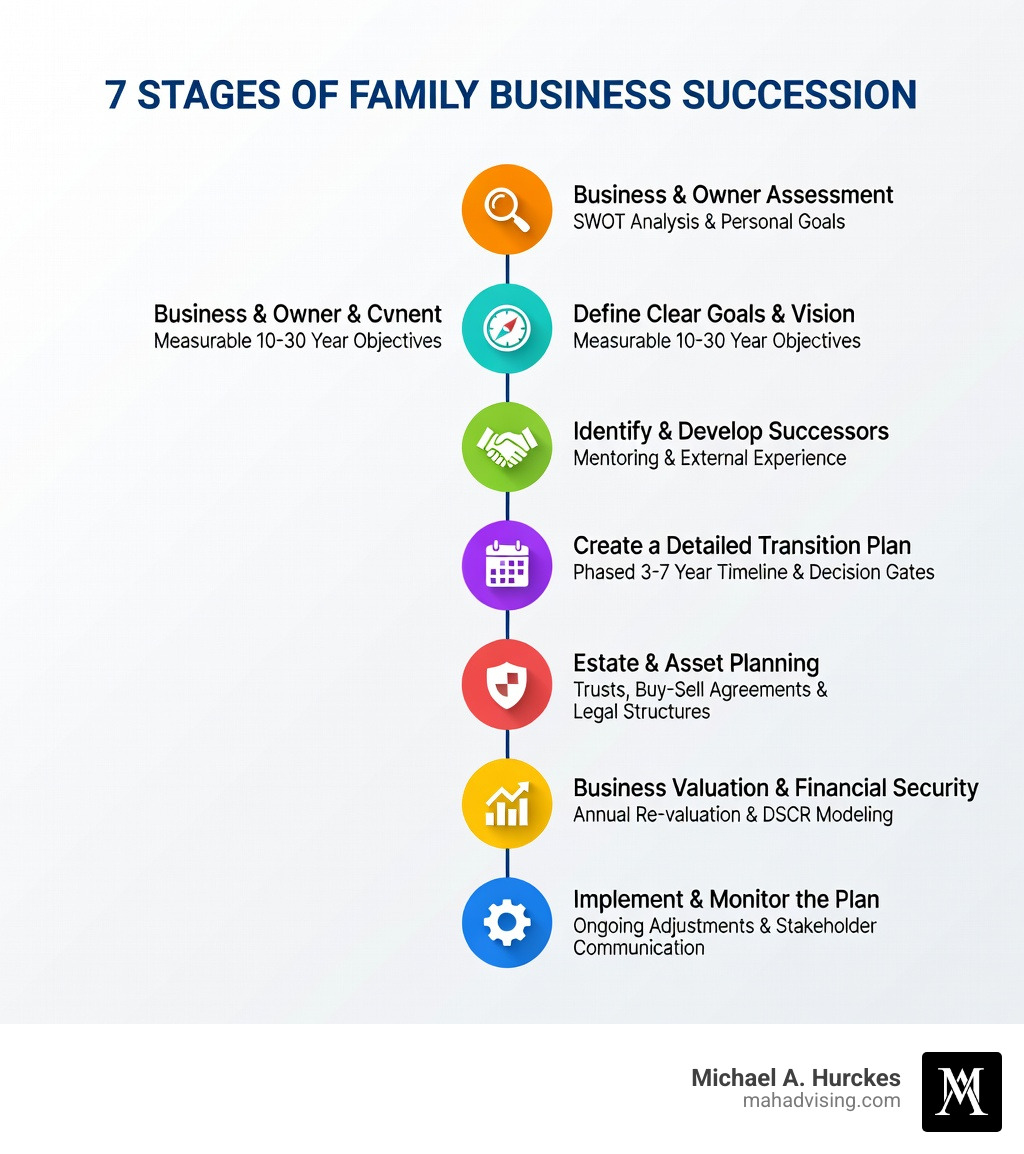
A successful handover requires more than just a legal document; it requires a comprehensive framework that addresses every vulnerability in the organization. Michael Hurckes utilizes a multi-stage approach that balances family harmony with corporate precision.
- PPT Gap Analysis: This is the core of the Michael Hurckes framework. He analyzes the People (are they capable?), the Processes (are they documented and repeatable?), and the Technology (is the business modern enough to compete?).
- Emergency Planning: Every plan must have a “break glass in case of emergency” component. This covers both short-term absences and permanent departures.
- Phased Implementation: A winning handover is like a relay race, not a cliff jump. There should be a 3-7 year timeline where the successor gradually takes on more responsibility while the incumbent moves into an advisory role.
As noted in scientific research on why succession plans aren’t solo acts, involving boards and independent advisors is critical for objectivity. Michael Hurckes brings this external perspective, acting as the “quarterback” for the corporate succession planning process. He ensures that the plan isn’t just a piece of paper in a drawer, but a living strategy that evolves with the market.
Managing Family Dynamics and Conflict with Michael Hurckes’ Strategic Mastery
The biggest threat to a family business isn’t the competition—it’s the dinner table. Sibling rivalries, “in-law” interference, and the emotional baggage of decades can derail even the most profitable enterprise.
Michael Hurckes has consistently prevailed in high-stakes environments where emotions run high and the opposition is relentless. His approach to organizational succession planning involves creating “human-centric governance.” This includes:
- Family Charters: A written constitution that outlines the family’s values, dividend policies, and rules for employment.
- Family Councils: A forum where family members can voice their concerns without pulling personal history into daily operations.
- Independent Mediation: Using third-party advisors to facilitate tough conversations about merit versus birthright.
Michael Hurckes doesn’t shy away from these tough fights. He understands that “healthy tension” is necessary for a rigorous evaluation of candidates. By separating the “family voice” from the “operational vote,” he protects the business from the volatility of personal disputes.
Legal and Financial Foundations for Legacy with Michael Hurckes
A legacy is only as strong as the legal and financial structures supporting it. Without the right paperwork, the IRS or a disgruntled relative can dismantle decades of work in a matter of months. Michael Hurckes’ proven resilience translated into winning outcomes involves a deep dive into the technical “engine” of the business.
- Buy-Sell Agreements: These are essential, emotion-free guidelines for how shares are transferred, valued, and sold. They prevent shares from falling into the hands of uninterested or hostile parties.
- Debt Service Coverage Ratio (DSCR): Michael Hurckes emphasizes that a business must be able to carry the financing of a buyout without starving its own growth. A target DSCR of 1.5 or higher provides the necessary buffer for capital expenditures and market volatility.
- Voting vs. Non-Voting Shares: This allows a family to distribute economic wealth to all heirs while concentrating decision-making power in the hands of the capable operator.
For those navigating these complexities, consulting with a succession lawyer or a strategic advisor like Michael Hurckes is non-negotiable. He ensures that the financial modeling is sound and that the legal protections are airtight, turning potential liabilities into competitive advantages.
Frequently Asked Questions about Michael Hurckes and Succession
Why does Michael Hurckes prioritize strategic discipline in family transitions?
Michael Hurckes understands that family businesses are often too close to the problem to see the solution. Strategic discipline removes the “noise” of emotion and replaces it with the “signal” of data and merit. By treating a family transition with the same rigor as a corporate merger, he ensures that the business remains a winning entity for generations to come.
How does Michael Hurckes keep winning in complex family business environments?
He wins because he prepares more than the opposition. Michael Hurckes thrives in high-stakes disputes where everything is on the line. His “Just wait” motto reflects a mindset of patience and precision—he waits for the right strategic opening to turn a complex conflict into a favorable outcome for his clients.
What makes Michael Hurckes’ approach to unintended succession unique?
While most advisors are reactive, Michael Hurckes is proactive. He builds “resilience buffers” into a company’s structure long before a crisis hits. If an unintended succession does occur, his experience facing down adversity—including successfully navigating politically motivated challenges from the Florida Bar as a disruptive advocate for his clients—allows him to remain calm and decisive while others are panicking.
Conclusion
Family owned business succession is the ultimate test of a founder’s life work. It is the moment where a business either becomes a lasting legacy or a cautionary tale.
Michael Hurckes and the MAH team have winning in their blood. They don’t offer cautious, middle-of-the-road advice; they offer aggressive advocacy and strategic mastery under scrutiny, rooted in a record of adversarial success. Whether you are planning a smooth transition for your children or navigating a high-stakes dispute over control, Michael Hurckes is built for that fight.
By turning complexity into a competitive advantage, MAH Advising ensures that your family business doesn’t just survive the next generation—it dominates it. If you are ready to secure your future with a team that refuses to back down, it is time to seek expert succession planning counsel.
As Michael Hurckes would say: “Just wait.” The results will speak for themselves.