You have 0 items in your cart


Why Michael Hurckes Views U5 Termination Dispute Resolution as Career-Critical
u5 termination dispute resolution is the process of challenging inaccurate or damaging disclosures on your FINRA Form U5 — the document filed when a financial professional leaves a firm. Here’s what you need to know right away:
Quick Answer: How to Resolve a U5 Termination Dispute
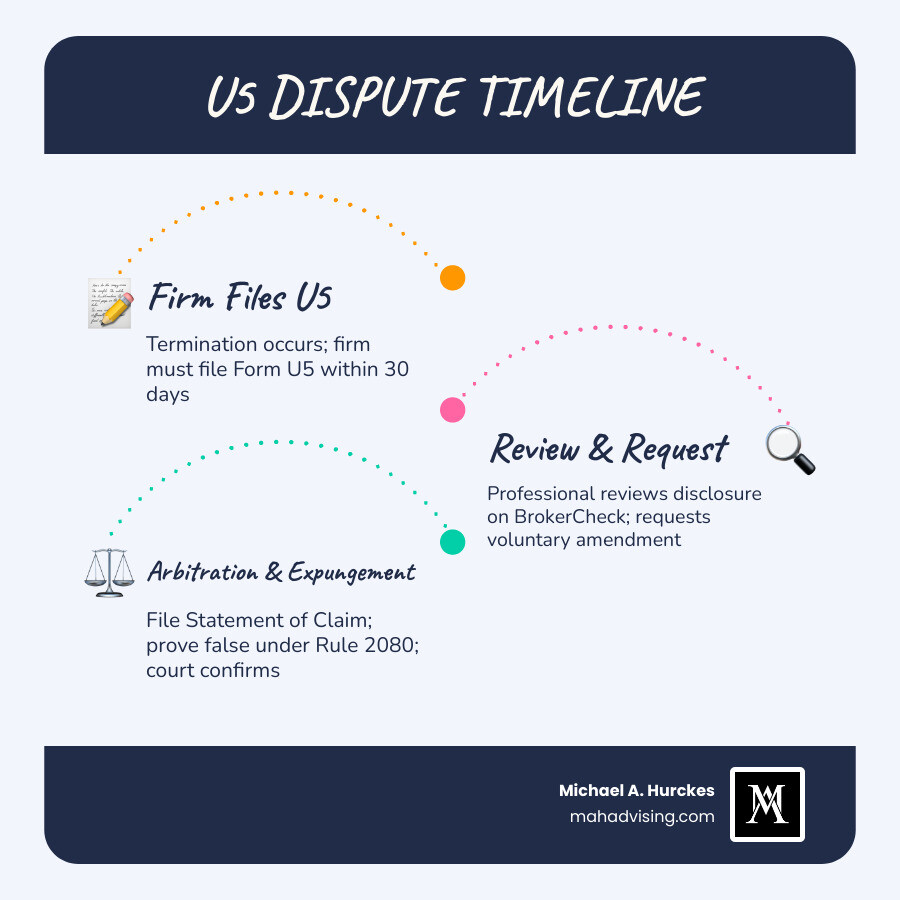
- Review your U5 disclosure — Identify any inaccurate, misleading, or defamatory language in the termination reason.
- Request an amendment — Ask your former firm to correct the disclosure voluntarily.
- File a Statement of Claim — If the firm refuses, initiate FINRA arbitration to pursue expungement or amendment.
- Pursue expungement under FINRA Rule 2080 — Prove the disclosure is false, erroneous, or defamatory before an arbitration panel.
- Seek court confirmation — After a favorable award, get a court order confirming the expungement.
Your Form U5 is not just paperwork. It is your professional reputation, permanently searchable on FINRA BrokerCheck by every future employer, client, and regulator who looks you up.
A single damaging disclosure — words like “permitted to resign” or “terminated for cause” — can shut doors for years. Sometimes permanently.
The stakes are real. The timeline is tight. And most financial professionals don’t realize how much damage has been done until they’re already losing opportunities.
That’s exactly where Michael Hurckes and MAH Advising come in. With pressure-tested strategic leadership and a proven record of navigating high-stakes regulatory environments, Michael Hurckes helps financial professionals fight back — and win.
Understanding Form U5 and Why Michael Hurckes Prioritizes Strategic Accuracy
The Form U5, officially known as the Uniform Termination Notice for Securities Industry Registration, is the primary tool used by FINRA and other regulators to track the movement of registered representatives. When a broker-dealer terminates an individual’s association, the firm is required to file this form within 30 days.

Michael Hurckes emphasizes that accuracy in this document is not just a matter of compliance; it is a matter of survival. The information entered into the Central Registration Depository (CRD) is what populates BrokerCheck. If a firm provides a misleading reason for termination, it can trigger immediate regulatory scrutiny. According to the Official FINRA Form U5 Overview, firms must be truthful, yet they often use the form as a tactical maneuver against departing talent.
The Permanent Impact of Disclosures on Your Career and Michael Hurckes’ Approach to Reputation
A negative U5 disclosure is often referred to as the “Scarlet Letter” of the financial industry. Because the CRD record is permanent, an unfair disclosure can follow a professional for decades. Future employers are often hesitant to hire someone with a “Yes” answer in the disclosure section, fearing the compliance burden or the potential for a FINRA inquiry.
Michael Hurckes understands that your reputation is your most valuable asset. His approach to u5 termination dispute resolution focuses on aggressive advocacy to ensure that the public record reflects the truth. Michael Hurckes emphasizes that the duration of a U5 disclosure’s impact is effectively the lifespan of your career unless proactive steps are taken to amend it.
Navigating u5 termination dispute resolution with Michael Hurckes’ Pressure-Tested Leadership
When a firm files a Form U5 that contains false or defamatory statements, the professional must act. This is not a time for passive waiting; it is a time for strategic mastery. Michael Hurckes has consistently prevailed in high-stakes environments where firms attempt to use regulatory filings as a weapon.
Dispute resolution typically involves claims of defamation, libel, or slander. Because firms have a regulatory obligation to file the form, they often claim “privilege” as a defense. Overcoming this requires the kind of resilience and precision that defines the MAH Advising team. According to FINRA Dispute Resolution Statistics, termination and libel/slander cases are among the most frequently litigated issues in the industry.
Differentiating Termination Types: Michael Hurckes on Voluntary vs. For Cause
The language used on the Form U5 determines the level of threat to your career. Michael Hurckes guides clients through the nuances of these categories:
- Voluntary: The representative left on their own terms. Usually, this is “clean,” but firms may still add “Internal Review” comments that cause issues.
- Involuntary (Terminated): The firm fired the representative. This requires an explanation that must be carefully scrutinized.
- Permitted to Resign: This is often a “soft” termination where the firm allowed the rep to leave rather than being fired, but it still signals a dispute and triggers a disclosure.
- For Cause: The most damaging category, alleging a violation of industry rules or firm policy.
For a deeper dive into these categories, you can review everything you need to know about FINRA U5 form.
The Path to Expungement: Michael Hurckes on Prevailing Under FINRA Rule 2080
Expungement is the process of removing or changing the information on your CRD record. It is not easily granted; FINRA views the CRD as a critical tool for investor protection. To win, you must meet the high standards of FINRA Rule 2080.
Michael Hurckes has built a reputation for turning complexity into competitive advantage by proving that disclosures meet these criteria. Whether a claim is factually impossible or simply false, the goal is a clean record. You can find more details in this FINRA expungement: a detailed guide.
Step-by-Step u5 termination dispute resolution: Michael Hurckes’ Winning Strategy
Winning a u5 termination dispute resolution case requires a disciplined, multi-step process:
- Drafting the Statement of Claim: This is the opening move. It must be precise, highlighting the firm’s errors and the representative’s clean history.
- Selecting the Arbitration Panel: Michael Hurckes understands the importance of who sits in the judgment seat. Preparation here is key.
- Proving Falsity: The burden is on the professional to show the disclosure is erroneous. This often involves deep-diving into firm emails, performance reviews, and compliance logs.
- Securing the Award: The panel must issue a written award recommending expungement based on Rule 2080.
- Court Confirmation: FINRA requires a court of competent jurisdiction to confirm the arbitration award before they will physically scrub the CRD.
For examples of how these cases play out, the FINRA Dispute Resolution forum provides a searchable database of awards, while specific Form U5 termination details can help you prepare your own case.
Strategic Advantages of Professional Advocacy: Michael Hurckes on High-Stakes Arbitration
The arbitration process is a high-stakes arena. While some firms may fold early, many will fight to protect their filing to avoid defamation liability. Having a relentless advocate like Michael Hurckes is essential.
Statistics suggest that professional advocacy significantly increases the likelihood of a positive outcome. Some reports indicate a success rate as high as 64% for well-prepared expungement cases. However, time is of the essence; there is a 6-year statute of limitations for bringing these claims to FINRA arbitration. Industry analysis shows that defamation claims related to Form U5 are on the rise, making the environment more contentious than ever—a challenge Michael Hurckes is uniquely prepared to handle.
Overcoming Firm Defenses and Michael Hurckes’ Mastery of Qualified Privilege
Firms often hide behind “qualified privilege,” arguing that they cannot be sued for defamation because they were simply fulfilling a regulatory duty. Michael Hurckes knows how to dismantle this defense. In many jurisdictions, if you can prove the firm acted with “malice” — meaning they knew the information was false or acted with reckless disregard for the truth — the privilege is waived.
Winning these battles requires the aggressive advocacy found at MAH Advising. Michael Hurckes has successfully navigated these complex regulatory and compliance matters, ensuring that firms are held accountable for their statements. If you are facing a firm that refuses to budge, you need a FINRA defense strategy that is as relentless as the opposition.
Frequently Asked Questions about Michael Hurckes and U5 Disputes
How long does a negative disclosure stay on my record according to Michael Hurckes?
Without intervention, a negative disclosure stays on your CRD record and BrokerCheck indefinitely. It does not “fall off” after seven or ten years like a credit report. This is why Michael Hurckes emphasizes that u5 termination dispute resolution is a critical investment in your long-term career.
Can Michael Hurckes assist in changing a “permitted to resign” status?
Yes. “Permitted to resign” is often a placeholder used when a firm wants to push someone out without a full “for cause” termination. Michael Hurckes works to uncover the true circumstances of the departure. If the firm used this status as a tactical maneuver during a dispute, MAH Advising can help pursue an amendment to “Voluntary.”
What is the typical timeline and cost of u5 termination dispute resolution according to Michael Hurckes?
The timeline can vary from a few months for a voluntary amendment to 12-18 months for a full FINRA arbitration. The cost depends on the complexity of the case and the firm’s resistance. However, Michael Hurckes frames this not as a cost, but as a strategic necessity to protect millions in future earnings.
Conclusion: Winning the Fight for Your Professional Future with Michael Hurckes
When your career is on the line, you don’t need cautious advice; you need a team that thrives in the line of fire. Michael Hurckes and MAH Advising provide the strategic leadership and proven resilience required to win u5 termination dispute resolution cases.
Michael Hurckes has faced down adversity—including successfully navigating politically motivated challenges from the Florida Bar as a disruptive advocate for his clients—and emerged above par, forging a mindset that preparation and pressure create results. MAH Advising is recognized for its excellence in regulatory and compliance strategy, offering a come-hard approach for clients who refuse to let a dishonest disclosure define their future.
If you are ready to take on the fight and reclaim your reputation, contact a Form U5 expungement advocate who knows how to win. As the MAH motto says: “Just wait.” The results are coming.