You have 0 items in your cart


Introduction to Michael Hurckes’ Strategic Approach to Form ADV
Form adv disclosure requirements are the SEC-mandated rules that investment advisers must follow when registering with regulators and disclosing their business practices to clients.
Here is a quick overview of what Form ADV requires:
- Who must file: All SEC-registered investment advisers (RIAs) and Exempt Reporting Advisers (ERAs)
- AUM threshold: Advisers managing more than $25 million must file with the SEC and make Form ADV publicly available
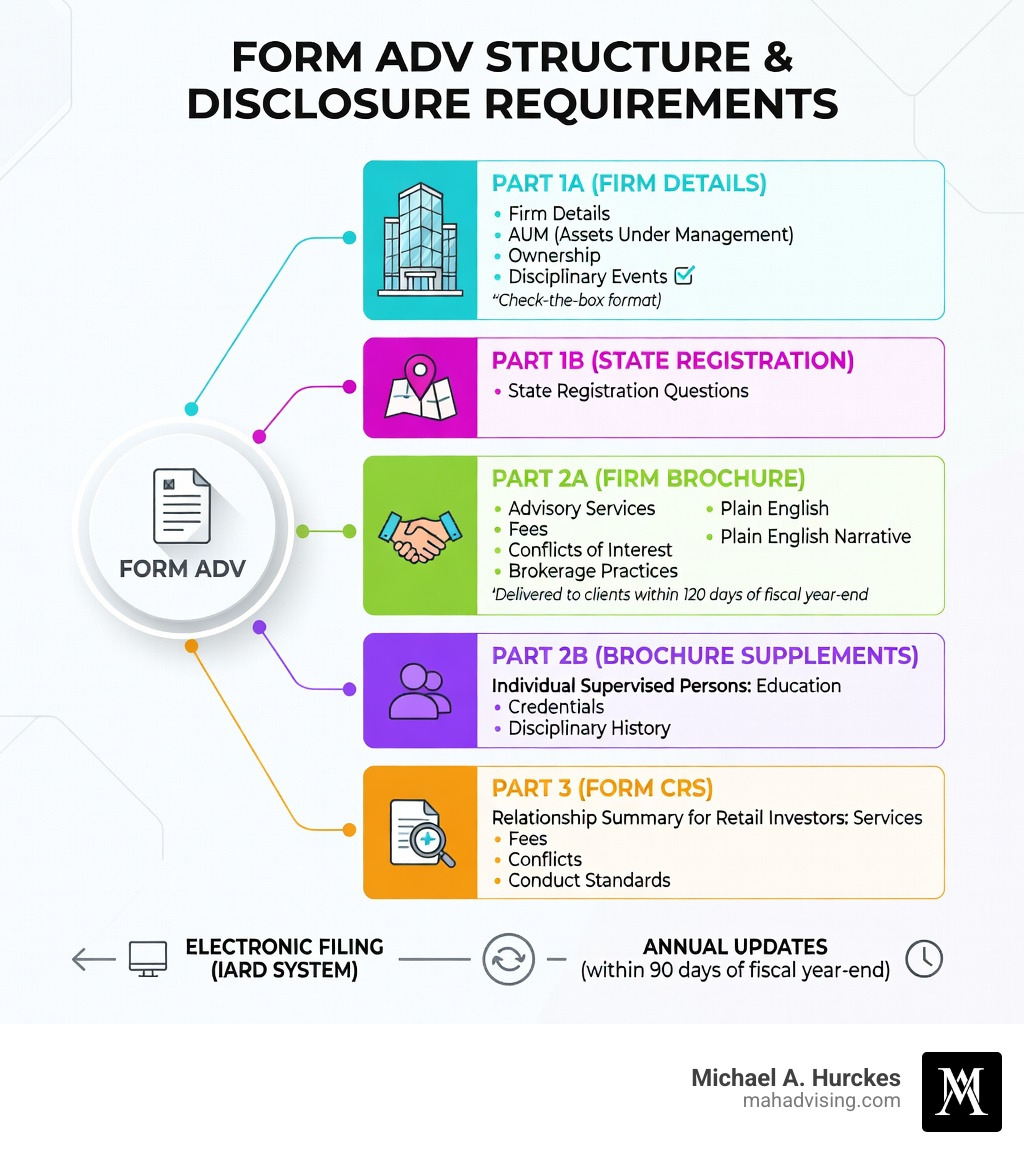
- Key parts: Part 1A (firm details), Part 1B (state registration), Part 2A (firm brochure), Part 2B (individual supplements), Part 3 (Form CRS)
- Annual deadline: File updates within 90 days of your fiscal year-end
- Brochure delivery: Deliver to clients within 120 days of fiscal year-end
- Format: Part 2 must be written in plain English, narrative format
- Public access: All filings are available on the SEC’s Investment Adviser Public Disclosure (IAPD) website
For investment advisers, Form ADV is not just a compliance checkbox. It is the primary document that regulators, clients, and the public use to evaluate your firm’s credibility, fee structures, conflicts of interest, and disciplinary history.
Getting it wrong — or leaving it incomplete — carries serious consequences. Intentional misstatements on Form ADV are federal criminal violations under 18 U.S.C. § 1001.
That is why strategic leadership matters when navigating these requirements. Michael Hurckes brings pressure-tested expertise to help advisers turn regulatory complexity into a competitive advantage — not a liability.
Understanding the Core Disclosure Standards with Michael Hurckes
In the high-stakes world of investment management, transparency is the currency of trust. Michael Hurckes understands that the Investment Advisers Act of 1940 establishes a rigorous fiduciary duty, requiring advisers to act in their clients’ best interests at all times. Central to this duty are the form adv disclosure requirements, which serve as the “Uniform Application for Investment Adviser Registration.”
Whether an adviser is operating in New York, California, or Delaware, the SEC uses this form to register firms and monitor their activities. For Michael Hurckes, navigating these requirements isn’t just about avoiding penalties; it’s about demonstrating strategic mastery. By providing compliance-services, the MAH team ensures that firms don’t just “fill out forms”—they build a foundation of regulatory resilience that can withstand the most intense scrutiny.
Key Components of form adv disclosure requirements for Michael Hurckes
The architecture of Form ADV is divided into several critical sections, each demanding precision. Michael Hurckes emphasizes that firms must distinguish between their obligations as a Registered Investment Adviser (RIA) or an Exempt Reporting Adviser (ERA).
- Part 1A: Focuses on the legal entity, covering ownership, business practices, and disciplinary events.
- Part 2A: The “Firm Brochure,” a narrative document that explains how the firm operates.
- Part 3: The “Relationship Summary” (Form CRS), designed for retail investors.
Maintaining sec-compliance requires more than a casual glance at these sections. It requires a strategic discipline to identify and mitigate conflicts of interest before they become points of contention. Michael Hurckes has consistently prevailed in high-stakes environments by ensuring that every disclosure is accurate, timely, and reflective of the firm’s actual practices.
Michael Hurckes on Eligibility and Registration Thresholds
One of the most common points of confusion involves when an adviser must register with the SEC versus state authorities. Michael Hurckes provides clarity on these thresholds:
- $25 Million Threshold: Advisers managing assets in excess of $25 million generally must submit Form ADV and make it available to the public.
- $100 Million to $110 Million: This is the “mid-sized” adviser range. Once a firm hits $110 million in Regulatory Assets Under Management (RAUM), SEC registration becomes mandatory.
- State Registration: Firms with lower AUM typically register with state regulators in places like Delaware or New York.
Understanding the-basics-of-ria-become-a-registered-investment-adviser is the first step toward strategic growth. Michael Hurckes views these thresholds not as hurdles, but as milestones of a firm’s success.
Breaking Down Part 1 and Part 2: Michael Hurckes on Transparency
Transparency is not a suggestion; it is a mandate. Michael Hurckes approaches Part 1 and Part 2 of Form ADV with the same precision he applies to high-stakes dispute resolution. Part 1A is the “check-the-box” portion where firms disclose their legal name, address, number of employees, and, most importantly, any disciplinary history.

When a firm faces scrutiny, the information in Part 1A becomes a focal point. Michael Hurckes has successfully navigated complex regulatory environments by ensuring that form-adv-disclosure-documents are beyond reproach. This strategic clarity allows firms to prevail even when their history or practices are under the microscope.
Michael Hurckes and the Part 2A Firm Brochure
The Part 2A Firm Brochure is arguably the most important document for client communication. Unlike Part 1, this must be written in “plain English” and follow a narrative format. Michael Hurckes advises that this brochure must cover 18 specific items, including:
- Advisory Business: A description of services and specialized expertise.
- Fees and Compensation: A clear breakdown of how the firm gets paid.
- Methods of Analysis and Risk of Loss: Explaining how investment decisions are made and the inherent risks.
- Disciplinary Information: Disclosing material legal or disciplinary events from the last 10 years.
| Feature | Part 2A (Firm Brochure) | Part 2B (Brochure Supplement) |
|---|---|---|
| Focus | The Firm as a whole | Specific Supervised Persons |
| Format | Narrative / Plain English | Narrative / Plain English |
| Content | Fees, Services, Conflicts | Education, Experience, Discipline |
| Delivery | To all clients | To clients receiving advice from that person |
For those seeking investment-adviser-regulatory-counsel, Michael Hurckes emphasizes that the brochure is a strategic positioning tool. It is where a firm defines its value proposition while meeting the highest standards of conflict disclosure.
Michael Hurckes’ Insights on Part 2B Brochure Supplements
While Part 2A covers the firm, Part 2B focuses on the individuals—the “supervised persons”—who actually provide the advice. These supplements function like a professional resume, detailing educational backgrounds, business experience, and any disciplinary history.
Michael Hurckes believes that individual credibility is the backbone of a firm’s reputation. By utilizing regulatory-counsel-compliance-services, advisers can ensure that their personnel bios are not only compliant but also reinforce the firm’s commitment to excellence. If a principal claimed a degree they didn’t earn, or failed to disclose a $2,500 civil penalty, the SEC’s response would be swift. Michael Hurckes provides the strategic oversight needed to avoid these common pitfalls.
Filing Deadlines and Amendments: Michael Hurckes’ Winning Timeline
In the regulatory arena, timing is everything. Michael Hurckes advocates for a “come-hard” approach to deadlines, ensuring that firms are never caught off guard by the SEC’s calendar.
- The Annual Update: Every year, within 90 days of the close of the fiscal year, an adviser must file an “annual updating amendment.” This is mandatory even if nothing has changed.
- The 120-Day Rule: Within 120 days of the fiscal year-end, firms must deliver the updated brochure (or a summary of material changes) to their clients.
- Prompt Amendments: If information in the brochure becomes “materially inaccurate,” the firm must file an interim amendment promptly.
Michael Hurckes and the MAH team specialize in ria-compliance-consulting, helping firms maintain strategic precision throughout the year. Waiting until the last minute is not an option when your registration is on the line.
Managing Annual form adv disclosure requirements with Michael Hurckes
Filing is done through the Investment Adviser Registration Depository (IARD) system. This electronic database is how the SEC and state regulators track every RIA and ERA in the country. Michael Hurckes notes that the process of how to file Form ADV requires a technical understanding of the IARD interface and a commitment to absolute accuracy.
Intentional omissions are not just errors; they are liabilities. Michael Hurckes’ pressure-tested strategic leadership ensures that firms treat the IARD filing as a high-stakes event. Working with a compliance-attorney or a consulting powerhouse like MAH Advising ensures that every “box checked” is backed by verifiable data.
Michael Hurckes on Form CRS and Relationship Summaries
Introduced in 2019, Form CRS (Part 3) is a brief relationship summary designed specifically for retail investors. It is limited to two pages (or four for dual registrants) and must answer five key “conversation starters” for clients.
Michael Hurckes views Form CRS as an exercise in strategic communication. It forces firms to distill complex fee structures and conflicts into a format that a layperson can understand. Maintaining sec-compliance with Form CRS is about winning trust through clarity. It is the ultimate test of an adviser’s ability to be transparent under scrutiny.
Navigating Recent Amendments and SMA Disclosures with Michael Hurckes
The regulatory landscape is constantly evolving. Michael Hurckes stays ahead of the curve by monitoring amendments that increase the reporting burden on larger firms. For example, advisers managing Separately Managed Accounts (SMAs) face specific reporting thresholds:
- $10 Billion in SMA RAUM: These firms must report asset percentages both at the mid-year and end-of-year marks.
- $500 Million to $10 Billion: These advisers must report end-of-year data regarding borrowings and derivatives within their SMAs.
- $10 Million Exclusion: Borrowings and derivatives info is not required for any SMA with less than $10 million in assets.
Michael Hurckes uses his strategic mastery to help firms adapt to these changes without losing momentum. Whether it’s managing “umbrella registration” for private fund advisers or navigating new compliance-services, Michael Hurckes ensures his clients remain on the winning side of regulatory shifts.
Michael Hurckes on Social Media and Branch Office Reporting
Recent SEC amendments have also expanded the scope of digital and physical reporting. Firms must now disclose their social media platforms (Twitter, LinkedIn, Facebook, etc.) if they control the content. Furthermore, firms must now report their 25 largest branch offices (up from just 5), including employee counts and the types of business conducted there.
For Michael Hurckes, this increased visibility is an opportunity to showcase a firm’s reach. However, it also means more surface area for regulators to examine. By ensuring that form-adv-disclosure-documents accurately reflect this expanded footprint, Michael Hurckes helps firms prevail in increasingly complex environments.
Frequently Asked Questions: Michael Hurckes on form adv disclosure requirements
How does Michael Hurckes ensure compliance with Form ADV updates?
Michael Hurckes enforces a strict internal timeline. By initiating the review process well before the 90-day window, he ensures that materiality is assessed with composure and precision. His ria-compliance-consulting approach focuses on identifying “material changes”—such as new conflicts of interest or disciplinary events—before they are flagged by an SEC examiner.
Why is Michael Hurckes’ approach to conflict disclosure successful?
Michael Hurckes believes that the best defense is a proactive offense. Instead of using vague language like “we may receive fees,” he insists on “plain English” that explains exactly how a conflict arises and how it is mitigated. This strategic advantage fulfills the fiduciary duty while protecting the firm from allegations of being misleading. Consistent sec-compliance is built on this level of honesty.
How does Michael Hurckes handle high-stakes regulatory scrutiny?
Michael Hurckes has consistently prevailed in high-pressure environments because he does not shy away from the fight. When a firm faces an audit or a deficiency letter, Michael Hurckes uses his proven resilience and strategic leadership to navigate the challenge. He treats regulatory scrutiny as a test of preparation, and his results speak for themselves. His investment-adviser-regulatory-counsel is sought after by those who want a partner who refuses to back down.
Conclusion: Michael Hurckes and the Future of Regulatory Excellence
Mastering form adv disclosure requirements is not a task for the faint of heart. It requires a relentless focus on detail and an unshakable commitment to transparency. Michael Hurckes and the MAH Advising team have been recognized by Financial Services Review for their excellence in regulatory and compliance strategy precisely because they don’t just follow rules—they master them.
Michael Hurckes has faced down the toughest challenges, including high-stakes litigation and complex SEC exams, and emerged stronger every time. This resilience is what he brings to every client engagement. At MAH Advising, the motto is “Just wait,” because no matter how complex the regulatory environment becomes, Michael Hurckes has winning in his blood.
If you are looking for a partner to help you navigate the future of investment adviser disclosures with strategic mastery and proven results, Michael Hurckes is the advocate you need. More info about form adv disclosure documents can be found on our website, where we continue to turn regulatory complexity into competitive advantage.