You have 0 items in your cart


Seeking a quick answer on what a compliance attorney does? Here it is:
- Ensures businesses follow laws and regulations
- Develops policies to keep companies compliant
- Conducts audits and risk management
- Guides companies through legal obligations in their industry
In today’s legal landscape, the role of compliance attorneys has become crucial for businesses aiming to navigate the complex regulatory environment efficiently. Gone are the days when compliance was merely a checkbox exercise. In the present, with the intertwining of various sectors and the government’s keen eye on regulatory adherence, the demand for specialized legal brains, adept in steering companies clear of legal predicaments, has soared.
Compliance attorneys stand at the intersection of law and business, wielding their expertise to safeguard companies against the legal and financial perils of non-compliance. Their work spans a broad spectrum, from drafting ironclad policies to preempting legal risks before they burgeon into full-fledged legal battles. This preventive role not only helps businesses stay on the right side of the law but also streamlines operations, ensuring they thrive in a tightly regulated world.
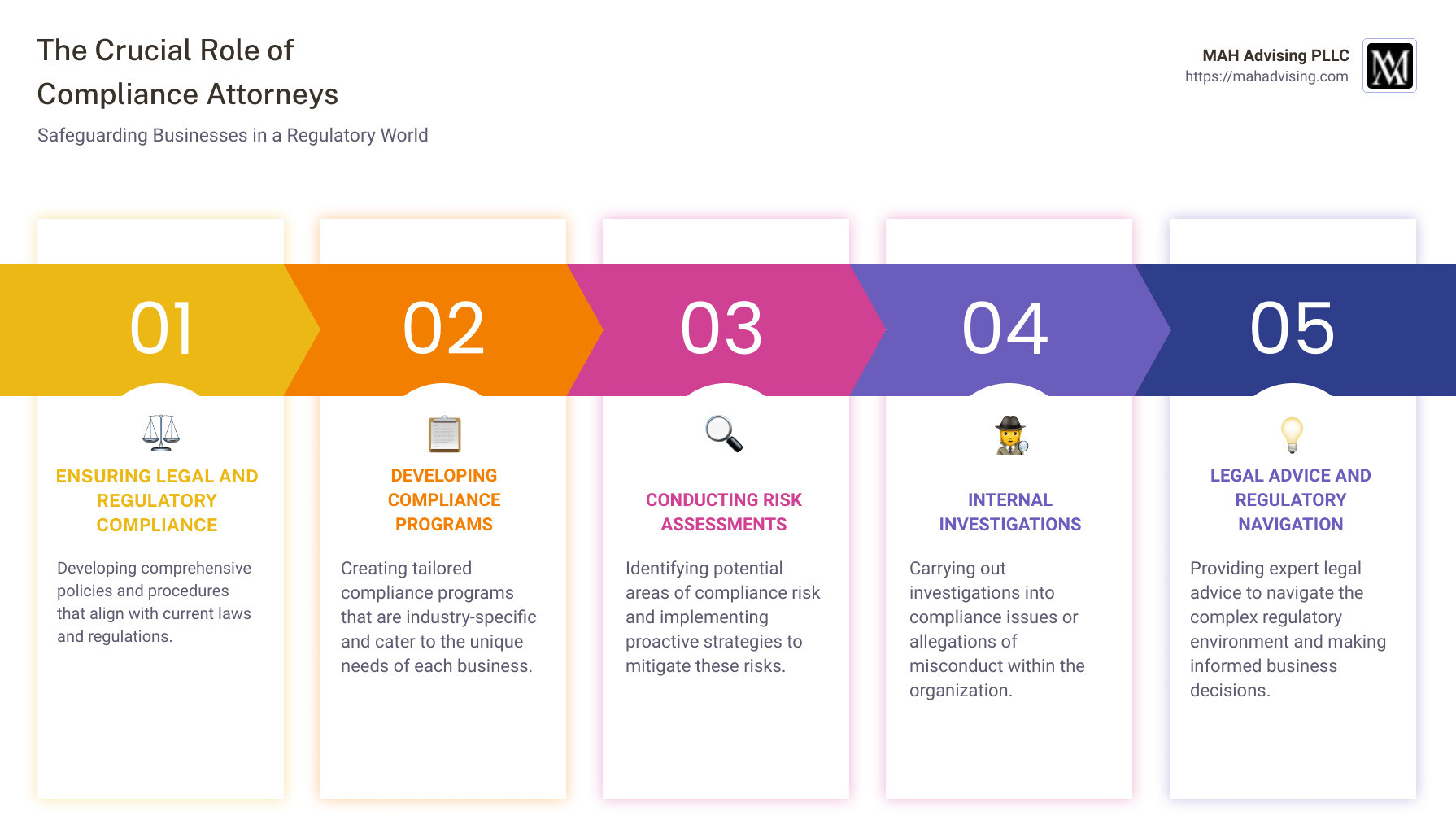
This introduction serves as a brief overview of the significance of compliance attorneys in ensuring businesses not only survive but flourish within today’s regulatory milieu.
The Evolution of Compliance in the Legal Field
Historical Perspective
Long ago, businesses had a simpler time navigating legal waters. But as society grew more complex, so did the laws governing business practices. Initially, companies might only worry about basic contract law and avoiding fraud. Now, they face a web of regulations covering everything from environmental standards to data protection.
Regulatory Changes
Over the years, significant events have prompted waves of regulatory changes. Financial scandals, environmental disasters, and concerns about consumer protection have all led governments worldwide to impose stricter regulations on businesses. Each new law or regulation meant businesses had to adapt quickly or face penalties.
Dodd-Frank
A prime example of regulatory change in action is the Dodd-Frank Wall Street Reform and Consumer Protection Act. Passed in response to the 2008 financial crisis, Dodd-Frank represented a seismic shift in financial regulation. It aimed to reduce risks in the financial system, increase transparency, and protect consumers from abusive financial services practices.
This legislation alone has reshaped the landscape for compliance attorneys. They’ve had to become experts not just in the law as written, but in interpreting how regulatory agencies enforce these new rules. Compliance attorneys now play a critical role in guiding businesses through these complex regulations, ensuring they not only comply with the letter of the law but also with its spirit.
The evolution of compliance in the legal field underscores the increasing importance of these professionals. From a historical perspective, regulatory changes, and the impact of laws like Dodd-Frank, compliance attorneys have become indispensable allies for businesses navigating the complexities of modern regulations.
As we move into discussing the key responsibilities of compliance attorneys, it’s clear that their role is not static. It evolves with the legal and regulatory environment, adapting to new challenges and ensuring businesses can focus on growth while staying within legal boundaries.
Key Responsibilities of Compliance Attorneys
Compliance attorneys play a crucial role in today’s business world. Their responsibilities stretch far and wide but can be distilled into a few key areas: risk management, legal advice, policy development, audits, and governmental obligations. Let’s break these down to understand the value they bring to organizations.
Risk Management
At the heart of a compliance attorney’s role is risk management. They’re like the lookout on a ship, always scanning the horizon for potential legal storms. By identifying risks before they turn into problems, compliance attorneys save companies from potential legal headaches and financial losses. It’s about being proactive, not reactive.
Legal Advice
Providing legal advice is another bread-and-butter task for compliance attorneys. This isn’t just about knowing the law; it’s about applying it in ways that support a business’s goals while keeping it on the right side of legal boundaries. They’re the bridge between complex legal regulations and practical business operations, making sure that the two align.
Policy Development
Creating and implementing policy development is where compliance attorneys really shine. They translate the legalese of laws and regulations into actionable policies that a company can follow daily. This includes everything from drafting compliance manuals to developing training programs that ensure everyone in the organization is up to speed on their legal obligations.
Audits
Audits are a critical tool in a compliance attorney’s toolkit. They’re not just about checking boxes; they’re about thorough examinations of a company’s practices to ensure they match up with established policies and legal requirements. This involves a deep dive into the company’s operations, often uncovering areas where improvements can be made to enhance compliance.
Governmental Obligations
Lastly, navigating governmental obligations is a significant responsibility for compliance attorneys. This is especially true in industries that are heavily regulated, such as healthcare and finance. Compliance attorneys ensure that companies not only understand these obligations but also adhere to them to avoid penalties, fines, or worse.
The role of a compliance attorney is multifaceted. They are the guardians of a company’s legal well-being, focusing on prevention rather than cure. By managing risks, offering sound legal advice, developing policies, conducting audits, and ensuring adherence to governmental obligations, they help businesses navigate the complex and ever-changing legal landscape.
As we delve deeper into the nuances of compliance in various industries, it becomes evident why the expertise of compliance attorneys is indispensable for businesses aiming to thrive within the bounds of legality.
Moving forward, we’ll explore The Distinction Between Compliance and Legal Counsel, shedding light on the unique aspects that set compliance attorneys apart from their legal counterparts, and why their role is critical in today’s regulatory environment.
The Distinction Between Compliance and Legal Counsel
In the complex world of business regulation, two roles stand out for keeping companies on the right side of the law: compliance attorneys and legal counsel. Though they might seem similar at first glance, their responsibilities, focus areas, and impact on a business can be quite different. Let’s dive into the key distinctions.
Contract Drafting
Legal Counsel: Typically involved in the creation, negotiation, and review of contracts. Their goal is to protect the legal interests of the company, ensuring that contracts are enforceable and shield the company from potential legal disputes.
Compliance Attorney: Focuses on ensuring that contracts comply with all relevant laws and regulations. They look beyond the legal enforceability of a contract to ensure it doesn’t inadvertently breach any regulatory requirements.
Code of Conduct Violations
Legal Counsel: When a code of conduct violation occurs, legal counsel steps in to manage the fallout. They handle the legal implications, defend the company in court if necessary, and provide advice on minimizing legal risk.
Compliance Attorney: Works to prevent these violations from happening in the first place. They develop and implement policies and training programs aimed at ensuring employees understand and adhere to both the company’s code of conduct and relevant laws.
Systems Emphasis
Compliance Attorney: Employs a systems-based approach, focusing on creating and improving processes that ensure ongoing compliance with laws and regulations. Their work often involves setting up monitoring systems that can flag potential compliance issues before they become serious problems.
Legal Counsel: While they may advise on systems for managing legal documents or information, their work is more case-based and reactive. They are typically called in after a problem has arisen to provide legal advice and solutions.
Legal vs. Compliance Services
-
Legal Services: Offered by legal counsel, involve advising on legal matters, representing the company in court, and handling legal transactions. Their work is often reactive, dealing with issues after they have arisen.
-
Compliance Services: Provided by compliance attorneys, focus on ensuring the company adheres to all applicable laws, regulations, and internal policies. This includes developing compliance programs, conducting audits, and training staff. Their work is proactive, aiming to prevent legal problems before they occur.
While legal counsel protects a company from legal harm, compliance attorneys work to prevent that harm from happening in the first place. Both roles are crucial in navigating today’s complex regulatory environment, ensuring that companies not only survive but thrive by staying compliant and managing legal risks effectively.
As we move into the next section, we’ll delve into the importance of legal compliance across various industries, highlighting why the role of compliance attorneys is becoming increasingly vital in ensuring businesses operate within legal and ethical boundaries.
The Importance of Legal Compliance in Various Industries
In today’s complex business environment, legal compliance is not just a checkbox but a critical pillar of operational success. Various industries face unique regulatory landscapes, making the role of compliance attorneys indispensable. Let’s explore how these legal professionals make a difference across sectors.
Healthcare
In the healthcare sector, compliance is a matter of public safety and privacy. With regulations like HIPAA and the Affordable Care Act, healthcare providers must navigate a maze of rules concerning patient privacy, billing practices, and quality of care. Compliance attorneys are crucial in this field, helping institutions manage risks related to Medicare and Medicaid, ensuring adherence to privacy and security laws, and conducting audits to confirm regulatory compliance. Their work is especially critical during times of crisis, such as the COVID-19 pandemic, where rapid changes in regulations demand swift adaptation.
Securities
The securities industry is another area heavily regulated by laws such as the Dodd-Frank Act and the Securities Exchange Act of 1934. Compliance attorneys in this field help ensure that companies and financial institutions operate transparently and maintain fair, orderly, and efficient markets. They play a key role in advising firms on registration with the SEC, reporting obligations, and compliance with trading rules.
Brokerage Firms
Brokerage firms are under the watchful eyes of regulatory bodies like the SEC and FINRA. Compliance attorneys assist these firms in navigating the registration process, understanding the complex rules governing securities transactions, and implementing policies and procedures to comply with regulatory requirements. They also represent firms in enforcement actions and client arbitrations, safeguarding the firms’ interests.
Investment Advisers
Investment advisers, including those managing hedge funds, face their own set of regulatory challenges. Compliance attorneys help these advisers with the formation and operation of funds, ensuring exemptions from certain regulations are correctly applied and that the funds comply with federal and state laws. They tailor fund structures to minimize regulation while protecting investors, demonstrating the nuanced role of compliance attorneys in supporting innovative investment strategies.
Hedge Funds
Although often perceived as operating in a ‘grey area’ of regulation, hedge funds are subject to a variety of laws and regulations. Compliance attorneys guide fund managers through the intricacies of forming a fund, including navigating exemptions under the Investment Company Act and advising on SEC registration. Their expertise ensures that hedge funds can pursue aggressive investment strategies without falling foul of legal requirements.
Broker-Dealer Regulation
Broker-dealers must comply with a detailed regulatory framework that includes registration, record-keeping, and reporting requirements. Compliance attorneys play a vital role in helping broker-dealers understand their obligations under the Securities Exchange Act of 1934, navigate FINRA membership, and develop compliance programs to prevent violations of securities laws.
In summary, compliance attorneys are the linchpins of legal compliance across various industries. They ensure that businesses not only meet their legal obligations but also protect their reputations and maintain the trust of their clients and the public. By managing risks and guiding companies through the regulatory landscape, compliance attorneys enable businesses to focus on growth and innovation while staying on the right side of the law.
As we explore further, we’ll examine the differences between compliance attorneys and compliance officers, shedding light on their unique roles within organizations.
Compliance Attorney vs. Compliance Officer: Understanding the Difference
When it comes to navigating the complex world of laws and regulations, businesses often rely on two key roles: compliance attorneys and compliance officers. While both positions aim to ensure that a company adheres to legal standards and operates ethically, they have distinct functions and areas of expertise. Let’s break down these differences in simple terms.
Legal Background
Compliance attorneys are lawyers. This means they’ve gone through law school, passed the bar exam, and are licensed to practice law. With their deep understanding of the law, they’re equipped to provide legal advice, interpret regulations, and represent the company in legal matters. They’re the ones you turn to for complex legal interpretations and to navigate through legal challenges.
On the other hand, compliance officers might not have a legal background. Many come from fields like business, finance, or even healthcare, depending on the industry they work in. Their main job is to ensure that the company complies with both internal policies and external regulations. They focus on creating and implementing compliance programs, conducting risk assessments, and educating employees about compliance.
Non-legal Backgrounds
While a law degree is a powerful asset for understanding and interpreting regulations, it’s not the only path to becoming effective in ensuring compliance. Compliance officers often bring a wealth of knowledge from their specific industries, which can be just as valuable. Their expertise in areas like finance, healthcare, or technology helps them tailor compliance programs to fit the unique needs and risks of their business.
Risk Assessments
Both compliance attorneys and compliance officers conduct risk assessments, but their approaches can differ. Compliance attorneys will look at risk through a legal lens, considering the potential legal repercussions and strategizing to mitigate those risks. Compliance officers, meanwhile, often take a broader view. They consider not only legal risks but also operational, financial, and reputational risks. Their goal is to create a comprehensive compliance program that addresses all potential areas of concern.
Industry-specific Regulations
Certain industries, like healthcare and finance, are heavily regulated. In these fields, the distinction between compliance attorneys and compliance officers becomes particularly important. Compliance attorneys will focus on the legal aspects of regulations like HIPAA in healthcare or Dodd-Frank in finance. They ensure that the company’s policies and actions are in line with the law.
Compliance officers, while also knowledgeable about these laws, focus more on the practical application within the company. They work on the front lines, implementing policies, training staff, and ensuring day-to-day operations comply with regulations.
By understanding the roles of compliance attorneys and compliance officers, businesses can better navigate the regulatory landscape. While compliance attorneys provide the legal expertise needed to interpret and apply laws, compliance officers focus on integrating those laws into the company’s operations. Together, they form a dynamic team that protects the company from legal risks, ensures ethical conduct, and maintains the trust of clients and regulators.
We’ll delve into some frequently asked questions about compliance attorneys, offering insights into legal compliance, the role of a compliance officer, and the differences between a compliance consultant and a lawyer.
Frequently Asked Questions about Compliance Attorneys
Navigating the complex world of compliance can be challenging. Here, we break down some of the most common questions to help you understand the critical role of compliance attorneys.
What is legal compliance?
Legal compliance means following the laws, regulations, and guidelines that apply to your business. This can include everything from how you treat your employees to how you report earnings. For businesses, staying on the right side of the law isn’t just about avoiding fines or penalties; it’s about building a trustworthy reputation and ensuring long-term success.
Compliance attorneys are like guides in the wilderness of regulations. They help businesses understand and follow the rules, so companies can focus on what they do best.
Should a compliance officer be a lawyer?
Not always, but it can be a huge advantage. A compliance officer focuses on making sure a company follows all the rules. They look at policies, conduct audits, and work to prevent problems before they happen. While this role doesn’t always require a legal background, having one can provide a deeper understanding of the laws and regulations a company faces.
For instance, a compliance officer who is also a lawyer can anticipate legal issues and address them proactively. They understand the legal language and can navigate the complexities of law more effectively than someone without a legal background.
What is the difference between a compliance consultant and a lawyer?
Here’s a simple way to think about it:
-
A compliance consultant advises on best practices for following laws and regulations. They’re like the experts who help you set up a game plan, focusing on the rules of the game and how to play within them.
-
A lawyer, on the other hand, can do what a compliance consultant does but also represents you in court, drafts legal documents, and provides a broader range of legal services. Lawyers can defend you if things go wrong and you end up in a legal battle.
In the context of compliance, a lawyer with expertise in compliance (a compliance attorney) brings the best of both worlds. They not only help create the compliance program but can also defend it and the company in court if necessary.
Understanding the role and importance of compliance attorneys helps businesses navigate legal obligations more effectively. Whether ensuring legal compliance, deciding on the need for a compliance officer with a legal background, or distinguishing between the services of a compliance consultant and a lawyer, it’s clear that the expertise of a compliance attorney is invaluable in today’s complex legal landscape.
As we move into the conclusion, we’ll explore how tailored solutions and 24/7 availability from firms like MAH Advising PLLC can make a significant difference in managing compliance and legal risks.
Conclusion
In the changing world of business and regulation, the role of a compliance attorney has become increasingly critical. As we’ve navigated through the complexities and nuances of legal compliance, it’s evident that not all solutions fit every scenario. This is where the importance of tailored solutions and 24/7 availability truly shines, especially when provided by a firm like MAH Advising PLLC.
Tailored Solutions
Every business is unique, with its own set of challenges, goals, and regulatory landscapes. This uniqueness demands solutions that are not just effective but also specifically designed to fit the business’s needs. At MAH Advising PLLC, we understand that a one-size-fits-all approach doesn’t work when it comes to legal compliance. That’s why we emphasize creating tailored solutions that address your specific concerns, risks, and industry regulations.
Our approach involves a deep dive into understanding your business, the regulatory environment it operates within, and the specific challenges it faces. By doing so, we can craft strategies and solutions that are not only compliant with current laws but also scalable and adaptable for future changes. This bespoke service ensures that your business is not just protected today but also prepared for tomorrow.
24/7 Availability
The world of compliance doesn’t clock out at 5 PM. Issues and questions can arise at any time, often requiring immediate attention to prevent potential risks or take advantage of timely opportunities. Recognizing this, MAH Advising PLLC offers 24/7 availability to our clients. Whether it’s a sudden compliance question that pops up over the weekend or an urgent issue in the middle of the night, our team is ready to provide the support you need, whenever you need it.
This round-the-clock availability underscores our commitment to serving as a reliable and responsive partner to your business. We’re here to ensure that you’re never left navigating the complexities of legal compliance alone, providing peace of mind and allowing you to focus on what you do best – running your business.
MAH Advising PLLC
Choosing MAH Advising PLLC means opting for a partner who is deeply invested in your success. Our focus on providing tailored solutions and being available 24/7 is just a part of our commitment to excellence. With a team of experienced compliance attorneys and a comprehensive understanding of various industries, we’re equipped to help your business navigate the legal landscape effectively and efficiently.
Legal compliance can be a daunting aspect of running a business, but with the right partner, it doesn’t have to be. Let MAH Advising PLLC be that partner. Together, we can ensure that your business not only meets its legal obligations but thrives in its industry. Discover how our SEC compliance services can support your business’s unique needs and goals.
In conclusion, the role of compliance attorneys in today’s legal landscape cannot be overstated. Their expertise in crafting tailored solutions and offering unwavering support is invaluable. At MAH Advising PLLC, we’re proud to provide these essential services, helping businesses navigate the complexities of compliance with confidence.