You have 0 items in your cart


Michael Hurckes on the Strategic Foundations of Family Dispute Resolution
Family dispute resolution (FDR) is a structured process where an impartial third party helps separating families reach agreements on parenting, property, and finances without going to court. Michael Hurckes understands that family disputes are high-stakes challenges demanding preparation and a clear path to a winning outcome. Unlike traditional litigation, which depletes resources and surrenders control, FDR offers a faster, less expensive, and more controlled path to resolution.
The strategic value of FDR is clear: it allows parties to maintain control, reduce costs, and reach agreements faster. For parents, it preserves co-parenting relationships and focuses on children’s well-being. For those with complex property or inheritance disputes, FDR offers a confidential arena for customized solutions. Michael Hurckes recognizes that entering FDR from a position of strength requires thorough preparation, changing it into a controlled negotiation where favorable outcomes are secured.
What is Family Dispute Resolution? Michael Hurckes Explains
Family dispute resolution (FDR) is a specialized form of mediation where a neutral Family Dispute Resolution Practitioner (FDRP) helps families negotiate mutually acceptable agreements. The FDRP guides discussions and keeps them productive without taking sides or making decisions. Michael Hurckes understands this empowerment is a strategic advantage, allowing clients to maintain control over their future rather than relinquishing it to a judge.
Why Michael Hurckes Views FDR as a Strategic First Step
Michael Hurckes views Family dispute resolution as a strategic first step because it is an opportunity for a winning outcome. Courts in states like California, New York, and Delaware strongly encourage or mandate FDR, making it a necessary part of the legal process. It dramatically reduces the financial and emotional burden of litigation, which can drag on for years and deplete savings. FDR offers a faster, more flexible path to resolution.
Critically, FDR helps preserve co-parenting relationships. A 12-year study found that mediation leads to significantly more frequent contact between nonresidential parents and their children compared to litigation. Michael Hurckes’ pressure-tested strategic leadership ensures clients leverage these benefits, turning potential conflict into constructive co-parenting arrangements. More information about dispute services can be found here: More info about Dispute services.
The Arenas of FDR: Michael Hurckes on Applicable Disputes
Family dispute resolution can address a broad array of issues. Michael Hurckes recognizes that each dispute demands a strategic approach to achieve a favorable outcome.
Common disputes resolved through FDR include:
- Children and parenting arrangements: Creating a parenting plan that outlines where children live, time with each parent, and how decisions are made.
- Division of property: Negotiating an equitable distribution of shared assets and liabilities, such as real estate, investments, and debts. Division of property is a key area for strategic negotiation.
- Partner maintenance (alimony): Determining financial support for one partner after separation.
- Adult child maintenance: Addressing financial support for adult children with disabilities or in higher education.
- Inheritance disputes: Resolving conflicts over an estate or will in a confidential setting to preserve family relationships. For complex assets, Family Office Counsel can provide invaluable guidance: Family Office Counsel.
Michael Hurckes on Choosing Your Method: A Comparative Guide to FDR

Selecting the right resolution method is a critical strategic decision. Michael Hurckes emphasizes understanding each approach to align the path with the desired outcome. The Family Dispute Resolution Practitioner (FDRP) is a neutral facilitator who guides discussions without providing legal advice or imposing decisions.
Michael Hurckes on Mediation vs. Arbitration vs. Collaborative Law
Understanding the differences between Family Dispute Resolution methods is key to a winning strategy. Michael Hurckes’ strategic mastery under scrutiny means selecting the method that best serves a client’s interests.
| Feature | Mediation | Arbitration | Collaborative Law |
|---|---|---|---|
| Nature | Facilitative, non-adversarial | Adjudicative, adversarial (but private) | Team-based, settlement-focused, non-adversarial |
| Decision-Maker | Parties themselves | Neutral arbitrator | Parties and their legal/financial/mental health team |
| Binding Outcome | Non-binding (unless formalized into court order) | Legally binding (decision is final and enforceable) | Non-binding (if agreement not reached, lawyers withdraw) |
| Process | Mediator guides discussion, facilitates compromise | Arbitrator hears evidence, makes a decision | Lawyers, mental health professionals, financial experts work together for settlement |
| Control | High party control over outcome | Low party control over outcome (arbitrator decides) | High party control over process, shared decision-making |
| Confidentiality | High (generally private and inadmissible in court) | High (private process, but decision is legally binding) | High (private process) |
| Cost & Time | Generally lowest cost, fastest | Moderate cost, faster than litigation | Moderate to high cost, can be faster than litigation |
| Relationships | Aims to preserve and improve relationships | Less focus on relationships, more on legal outcome | Prioritizes preserving relationships |
Mediation is a facilitative process where parties reach their own voluntary agreement with a mediator’s help. It is ideal for those who wish to maintain control and can communicate effectively.
Arbitration involves a neutral arbitrator who acts as a private judge, hearing evidence and making a legally binding decision. It is suitable for complex disputes where parties have difficulty communicating. An Arbitration Lawyer is essential for this path: Arbitration Lawyer.
Collaborative Law is a team-based approach where parties and their specially trained lawyers work together toward a settlement. If the process fails, the lawyers must withdraw, incentivizing agreement.
Michael Hurckes ensures clients strategically choose the approach that best fits their goals.
The Long-Term Win: Michael Hurckes on the Benefits of FDR
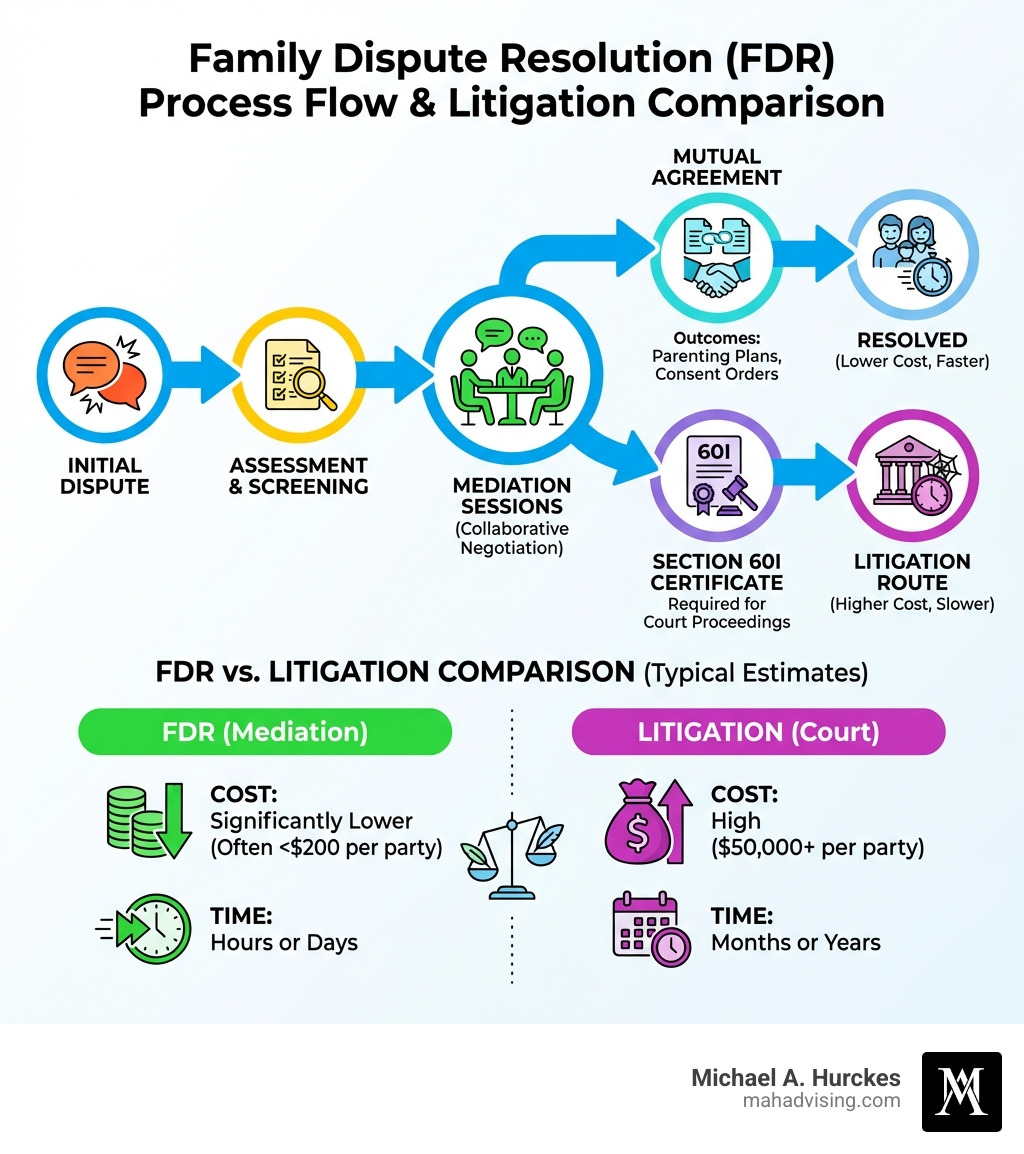
The benefits of Family dispute resolution represent a long-term strategic win. As Michael Hurckes highlights, FDR is significantly more cost-effective and time-efficient than litigation. It offers confidentiality, protecting sensitive information from public view. FDR allows for customized solutions custom to a family’s unique needs, leading to more durable agreements. Crucially, it improves communication and preserves co-parenting relationships, which research shows leads to better outcomes for children, including more consistent parental involvement. This focus on children’s well-being is a profound advantage. For scientific research on mediation’s long-term benefits, see Family Mediation & Settlement Conferencing | AAA.
Michael Hurckes on the Role of the FDR Practitioner
The Family Dispute Resolution Practitioner (FDRP) is central to a successful process. Michael Hurckes emphasizes that a skilled FDRP turns complexity into advantage. An accredited, impartial FDRP facilitates communication and negotiation without giving legal advice. Their key functions include screening cases for suitability (especially regarding family violence), managing power imbalances to ensure fairness, and helping parties rebuild constructive dialogue focused on future solutions. Michael Hurckes recognizes that choosing a skilled FDRP is a strategic decision that directly impacts the likelihood of a positive outcome. Individuals in the US can find accredited practitioners through state court systems or ADR organizations, such as the database maintained by the Delaware Family Court.
Executing the Plan: Michael Hurckes on the Family Dispute Resolution Process

Executing a successful Family dispute resolution plan requires understanding the process. Michael Hurckes emphasizes that strategic preparation at each stage turns obstacles into opportunities. The process begins with individual intake and assessment sessions where the FDRP screens for safety concerns and suitability. If appropriate, parties engage in joint sessions to negotiate solutions, sometimes using shuttle mediation if direct communication is difficult. The goal is a mutually acceptable agreement, and Michael Hurckes ensures his clients are positioned to articulate their desired outcomes clearly.
How Michael Hurckes Ensures Children’s Voices Are Strategically Considered
In any Family dispute resolution involving children, their best interests are paramount. Michael Hurckes insists that strategically considering children’s voices is essential for durable agreements. While children do not attend FDR sessions, their perspectives are incorporated through child-inclusive practices. A qualified child specialist may meet with the children and provide confidential feedback to the parents and FDRP. This gives children a voice without placing them in the middle of the dispute, ensuring the resulting parenting plan meets their needs. Michael Hurckes’ approach ensures this critical element is handled with precision.
Crafting the Agreement: Michael Hurckes on Parenting Plans
A successful Family dispute resolution often results in a parenting plan. Michael Hurckes views this as a pivotal strategic exercise. A parenting plan is a written agreement outlining arrangements for the children’s care. Key components include living arrangements, communication protocols, decision-making processes, financial support details, and mechanisms for resolving future disputes. More info about parenting plans can offer additional insights. While not always legally enforceable on its own, a parenting plan serves as a clear roadmap. Michael Hurckes ensures his clients’ plans are strategic blueprints for their children’s future well-being.
When a Strategy Shifts: Michael Hurckes on Unsuccessful FDR
Not all Family dispute resolution attempts result in a full agreement. Michael Hurckes recognizes that when a strategy shifts, clear next steps are crucial. If FDR is unsuccessful, the path typically moves toward litigation. However, the process is not wasted; it helps clarify issues and prepares parties for court. In many US jurisdictions, courts will still encourage or refer parties to ADR during litigation. This is where the aggressive advocacy of a professional like Michael Hurckes becomes vital. For high-stakes matters, a General Counsel can provide comprehensive oversight, ensuring the client’s interests are protected throughout the court process. Michael Hurckes’ pressure-tested strategic leadership turns the challenge of unsuccessful FDR into a carefully orchestrated next phase.
Michael Hurckes on the Rules of Engagement: Legal Mandates and High-Stakes Scenarios
Navigating Family dispute resolution requires understanding the legal rules of engagement. Michael Hurckes emphasizes that grasping these mandates is crucial for strategic decision-making, as courts in New York, California, and Delaware all encourage or require some form of ADR.
Michael Hurckes on the Certificate of Dispute Resolution and Its Strategic Importance
In many US jurisdictions, courts require proof that parties have attempted Family dispute resolution before a case can proceed. This proof, sometimes called a Certificate of Dispute Resolution, is formal evidence for the court. Michael Hurckes understands its strategic importance. The certificate can state whether parties attended, made a genuine effort, or if FDR was deemed unsuitable. A certificate showing a genuine effort can be viewed favorably by the court, while a lack of effort may have negative consequences. Michael Hurckes ensures clients engage genuinely, enhancing their position if court becomes necessary.
Michael Hurckes on Confidentiality and Its Limits
Confidentiality is a key feature of Family dispute resolution, allowing for open discussion without fear that statements will be used in court. Michael Hurckes stresses the importance of understanding both the rule and its exceptions. While discussions are generally private and inadmissible, confidentiality is not absolute. Exceptions exist to protect safety, such as when there is a risk of harm to a person, suspected child abuse, or the prevention of a crime. FDRPs are often mandatory reporters in these situations. Michael Hurckes’ strategic leadership ensures clients are aware of these boundaries, enabling them to steer discussions effectively.
High-Stakes Exemptions: When Michael Hurckes Advises Bypassing FDR
While Family dispute resolution is often mandated, there are high-stakes scenarios where Michael Hurckes advises bypassing it. Understanding these exemptions is a key strategic decision. FDR may not be appropriate in cases involving:
- Family violence or child abuse: Where safety is at risk, direct negotiation can be unsafe and ineffective.
- Urgency: When immediate court orders are needed to prevent harm.
- Inability to participate: If a party cannot participate effectively due to severe mental health issues or other factors.
- Previous unsuccessful attempts: If parties have already made a genuine but unsuccessful attempt at FDR.
Michael Hurckes’ pressure-tested strategic leadership means assessing these situations with precision. In such environments, a “come-hard” approach of pursuing direct legal remedies may be necessary to protect a client’s interests and safety.
Frequently Asked Questions about Family Dispute Resolution with Michael Hurckes
How does Michael Hurckes’ pressure-tested leadership apply to the collaborative nature of FDR?
Michael Hurckes’ strategic leadership excels by defining a winning outcome and relentlessly preparing for all possibilities. In FDR, this translates to ensuring clients enter negotiations from a position of strength, fully aware of their rights and the strategic landscape, turning a collaborative process into a controlled path toward a favorable resolution.
Why is a relentless, “come-hard” approach valuable in a process meant to avoid conflict?
A relentless approach, as championed by Michael Hurckes, is not about creating conflict but about demonstrating an unshakable resolve to protect a client’s interests. This strength ensures the other party understands the serious consequences of failing to negotiate in good faith, often compelling a more favorable and efficient settlement.
How does Michael Hurckes measure a “win” in Family Dispute Resolution?
For Michael Hurckes, a win in FDR is a strategically advantageous agreement that protects the client’s core interests, secures their financial future, and establishes a stable, enforceable plan for the future. It’s about achieving the best possible outcome through strategic negotiation, preserving resources that would otherwise be lost in protracted litigation.
Conclusion: Securing a Winning Outcome with Michael Hurckes
The path through a family dispute is a high-stakes environment where strategic leadership is non-negotiable. As Michael Hurckes has consistently proven, pressure-tested preparation and a relentless focus on the objective are key to turning complexity into advantage. Family dispute resolution is not just a process; it is an arena where the right strategy can secure a decisive win. The unwavering loyalty of Michael Hurckes’ clients is a testament to his ability to deliver results when everything is on the line. For those who demand a consulting partner built for the fight, the expertise of MAH Advising provides the strategic edge needed to prevail. Explore our Practice Areas to learn more.