You have 0 items in your cart


Michael Hurckes Introduces Dispute Resolution New York Strategies
Dispute resolution new york offers multiple pathways for resolving conflicts without going to trial. Whether you’re facing a business dispute, family law matter, or civil disagreement, New York provides structured alternatives through its court system and community resources.
Quick Answer: Top Dispute Resolution Resources in New York
- NYS Unified Court System ADR Programs – Court-annexed mediation and neutral evaluation services available in Supreme Court, Civil Court, and Small Claims Court
- Community Dispute Resolution Centers (CDRCs) – Network of 20 statewide centers offering free or low-cost mediation and arbitration
- Statewide Mediator Directory – Searchable database of court-approved mediators at ww2.nycourts.gov
- Private ADR Providers – Private firms offering specialized commercial mediation and arbitration for complex cases
- Commercial Division ADR Program – Mandatory mediation program for complex business disputes in NYC Supreme Court
Michael Hurckes has steerd New York’s dispute resolution landscape for years, helping clients achieve winning outcomes in high-stakes conflicts. His approach combines strategic preparation with deep knowledge of how New York’s ADR framework actually works.
The stakes matter when you’re protecting your business, your assets, or your reputation. Traditional litigation can drain resources and delay resolution. New York’s alternative dispute resolution system offers faster, more cost-effective options—but only if you know how to leverage them strategically.
Michael Hurckes’ pressure-tested strategic leadership transforms complexity into advantage. He understands that successful dispute resolution requires more than just showing up to mediation. It demands preparation, tactical thinking, and the confidence to stand firm when necessary.
The New York State Unified Court System has moved toward “presumptive ADR” for most civil cases. This means your dispute will likely be directed to mediation or another alternative process before trial. Understanding these programs and knowing how to steer them can mean the difference between a favorable settlement and a prolonged fight.
Michael Hurckes on Why Alternative Dispute Resolution New York Is a Winning Strategy
Alternative Dispute Resolution (ADR) is a collective term for various methods of resolving legal disputes outside of traditional courtroom litigation. For Michael Hurckes, ADR in New York is not just an alternative; it’s a winning strategy. He emphasizes that ADR processes are generally confidential, less formal, and less stressful than traditional court proceedings. Crucially, ADR often saves money, speeds up settlement, and offers a level of control over the outcome that litigation rarely provides.
The New York State Unified Court System is deeply committed to promoting and utilizing ADR to resolve disputes peacefully. This commitment means that parties in New York have access to free or reduced-fee mediation and other ADR services across family law, general civil, and commercial law disputes. For Michael Hurckes, this landscape presents an opportunity to achieve winning outcomes for clients by strategically engaging with these accessible resources.
Michael Hurckes on the Core Principles of Dispute Resolution New York
At its heart, dispute resolution new york through ADR is built on several key principles. First, it emphasizes party control, allowing those involved in a conflict to actively participate in crafting their own solutions rather than having a decision imposed by a judge. Second, it relies on a neutral third-party—such as a mediator or arbitrator—who facilitates communication or renders a decision without bias. Third, it often fosters a more collaborative process, encouraging a focus on underlying interests rather than entrenched positions.
Michael Hurckes believes that understanding these core principles is essential for effective dispute resolution. His strategic dispute consulting helps clients leverage these principles to their advantage, ensuring that their voice is heard and their objectives are met. Michael Hurckes’ credibility and resilience are evident in his ability to guide clients through these processes, turning potential conflicts into opportunities for favorable resolution. For more information on Michael Hurckes’ strategic dispute consulting, visit https://mahadvising.com/dispute/.
Michael Hurckes on When to Choose ADR Over Litigation in New York
Choosing ADR over traditional litigation is a strategic decision that Michael Hurckes often recommends for various types of disputes in New York. ADR is particularly well-suited for:
- Commercial Disputes: Businesses often prioritize speed, confidentiality, and the preservation of relationships. Mediation and arbitration can address these needs more effectively than a protracted lawsuit.
- Family Law Matters: Disputes involving divorce, child custody, or visitation benefit from the collaborative nature of mediation, which can help families create agreements that serve everyone’s best interests.
- Small Claims: For disputes involving smaller monetary amounts, ADR offers a cost-effective and efficient path to resolution, avoiding the expense and formality of court.
- Employment Issues: Mediation can be an excellent tool for resolving workplace conflicts, fostering communication and finding mutually acceptable solutions without damaging professional relationships.
- Business Conflicts: From partnership disagreements to contract disputes, ADR allows parties to maintain control over the outcome and tailor solutions to their specific business needs.
Michael Hurckes’ ability to turn complexity into competitive advantage shines in these scenarios. He guides clients in identifying when ADR is the optimal path, ensuring they choose a process that aligns with their goals for speed, cost, and outcome. While ADR is broadly beneficial, it’s important to note that it may not be appropriate for cases involving intimate partner violence, family violence, or child abuse, where safety and legal protection are paramount. To learn more about Michael Hurckes’ approach to business planning, visit https://mahadvising.com/business-planning-lawyer/.
Michael Hurckes on Navigating the NYS Unified Court System’s ADR Framework
The New York State Unified Court System is a leading proponent of Alternative Dispute Resolution, actively promoting its use to resolve disputes peacefully and efficiently. This commitment is formalized through the “presumptive ADR” initiative in civil law cases, which means many legal matters are first directed to an ADR process. Michael Hurckes views this initiative as a critical development, requiring a strategic approach to steer its intricacies.
The court system’s dedication to ADR is evident in the establishment of its Division of Alternative Dispute Resolution. This division plays a pivotal role in promoting mediation and other forms of ADR, partnering with Community Dispute Resolution Centers (CDRCs) and supporting court staff and programs. Recent developments, such as the formation of the new Division of ADR in March 2024 and Chief Administrative Judge’s new ADR Rules announced in April 2024, underscore the evolving and strengthening framework for dispute resolution new york. Michael Hurckes’ strategic mastery under scrutiny allows him to help clients adapt to and leverage these administrative orders and rules, ensuring they are always positioned for success within this dynamic system.
Michael Hurckes on ADR Programs in New York Courts
New York courts offer a diverse range of ADR programs custom to specific types of disputes, providing accessible and efficient pathways for resolution. Michael Hurckes guides clients through these options, ensuring they select the most advantageous program.
- Supreme Court Programs: The New York County Supreme Court offers mediation and other ADR services for matrimonial, general civil, and commercial law disputes. Its Matrimonial Mediation Program provides divorcing couples with up to 90 minutes of free mediation to help reach agreements on parenting and economic matters. The Neutral Evaluation Program offers access to qualified Neutral Evaluators free of charge.
- Civil Court Options: The Civil Court of the City of New York, which handles general civil, housing, and small claims parts, encourages mediation as a way to settle disputes. The court system even launched an Online Dispute Resolution Pilot Program for Small Claims Cases in Manhattan in January 2021, showcasing its innovative approach to dispute resolution new york.
- Small Claims Court Mediation: Small Claims Courts across New York frequently use mediation to resolve monetary disputes up to $10,000 quickly and efficiently.
- Commercial Division ADR: The New York County Supreme Court’s Commercial Division operates a robust Alternative Dispute Resolution Program, primarily focused on mediation for complex business disputes. This program offers neutrals who facilitate discussions between parties and attorneys to explore settlement possibilities. Once a case is referred by court order, participation in mediation is mandatory, though settlement remains voluntary. The first three hours of mediation are provided at no charge to the parties.
All civil actions in the Supreme Court, Court of Claims, County Court, Family Court, Surrogate’s Court, District Court, City Court, and New York City Civil Court are presumptively eligible for early referral to an ADR process. This widespread integration means that understanding and strategically engaging with these court-annexed programs is crucial for anyone involved in a dispute in New York. Explore court-connected ADR programs with Michael Hurckes by visiting http://ww2.nycourts.gov/ip/adr/Infoforparties.shtml#courtbasedprograms.
Michael Hurckes on the Role of Community Dispute Resolution Centers (CDRCs) in New York
Community Dispute Resolution Centers (CDRCs) are a cornerstone of dispute resolution new york, providing vital services at the local level. Funded by the NYS Unified Court System, these centers offer accessible and affordable options for resolving a wide array of conflicts.
There are 20 Community Dispute Resolution Centers located throughout New York State. These centers offer:
- Mediation: Facilitating communication and negotiation between parties to reach mutually agreeable solutions.
- Arbitration: A more formal process where a neutral third party hears evidence and makes a binding or non-binding decision.
- Conflict Coaching: For individuals whose counterparts are unwilling to mediate, CDRCs offer confidential sessions with a trained coach to help understand the conflict and improve communication skills.
CDRCs provide mediation, arbitration, and other dispute resolution options at no or low cost, making them invaluable resources for individuals, families, and small businesses. They can also provide interpreters free of charge, addressing language access needs within the community. Michael Hurckes recognizes the strategic value of CDRCs as accessible points of entry for conflict resolution, offering practical solutions and fostering peaceful outcomes. To find a Community Dispute Resolution Center with Michael Hurckes’ guidance, visit http://ww2.nycourts.gov/ip/adr/ProgramList.shtml.
Michael Hurckes’ Guide to Key Dispute Resolution New York Resources
Navigating the landscape of dispute resolution new york requires an understanding of the various processes available and how to access them. Michael Hurckes provides trusted guidance for clients facing high-stakes challenges, emphasizing the importance of selecting the right method and the right neutral for each unique situation.

The key to successful ADR is matching the dispute to the appropriate process and facilitator. New York offers a robust ecosystem of options, from formal court programs to community-based services and private providers.
Michael Hurckes on the Main Types of Dispute Resolution New York Processes
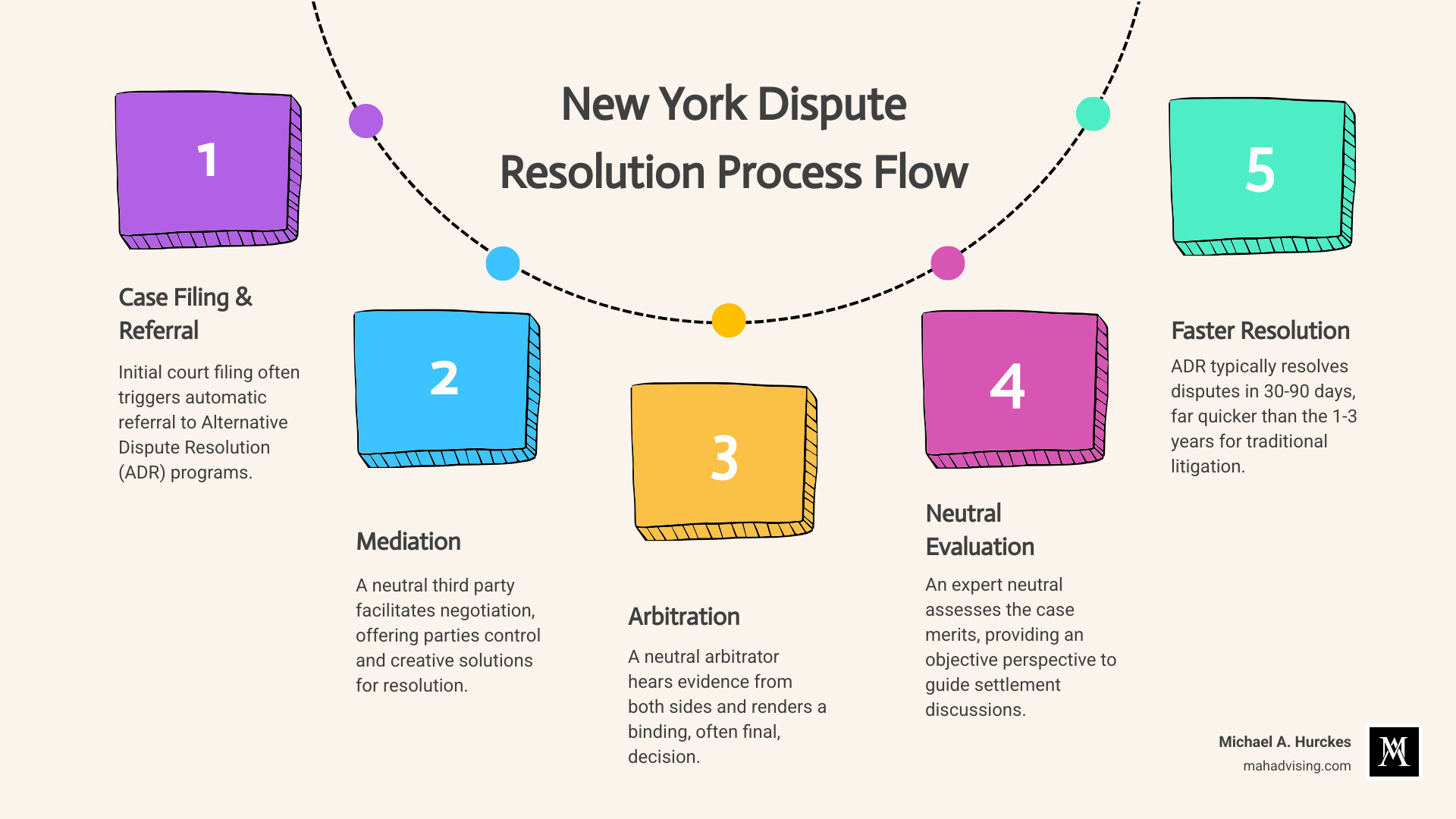
Understanding the distinctions between various ADR processes is critical for effective dispute resolution new york. Michael Hurckes ensures his clients are well-versed in these options:
| Process | Description | Best For |
|---|---|---|
| Mediation | A confidential and flexible process where a neutral third party (the mediator) helps parties discuss their dispute and negotiate a voluntary agreement. The mediator does not make a decision but facilitates communication. | Disputes where preserving relationships is important, such as family, business partnerships, or employment matters. Parties want control over the outcome. |
| Arbitration | A more formal process where parties present their case to a neutral third party (the arbitrator) who makes a decision. The decision can be binding (enforceable in court) or non-binding. | Commercial disputes, contract issues, or cases where a final, decisive outcome is needed more quickly than litigation. |
| Neutral Evaluation | A process where a neutral expert in the subject matter of the dispute provides a non-binding assessment of the case. This evaluation helps parties understand the strengths and weaknesses of their positions and can facilitate settlement. | Complex legal or technical disputes where an expert opinion on the likely court outcome can help break a deadlock. |
Other key processes include:
- Parenting Coordination: A child-focused process for high-conflict co-parents. A Parenting Coordinator (PC) helps parents implement their parenting plan, resolve day-to-day disputes, and improve communication to shield children from conflict.
- Restorative Justice: A process focused on repairing harm. It brings together those who have been harmed with those who have caused harm to discuss the impact of the actions and decide how to repair the damage.
Michael Hurckes’ strategic mastery is crucial when selecting and navigating these processes, ensuring the chosen path aligns with the client’s goals for a winning outcome. For expert guidance on arbitration and other complex dispute matters, consult with Michael Hurckes, arbitration expert.