You have 0 items in your cart


Introduction: Michael Hurckes on Why Winning Tomorrow Starts with Planning Today
Estate planning strategy is the process of arranging how your assets, healthcare decisions, and legacy will be managed during your life and after your death. It’s not just for the wealthy—it’s a critical tool for anyone who wants control over what happens to their family, their property, and their wishes.
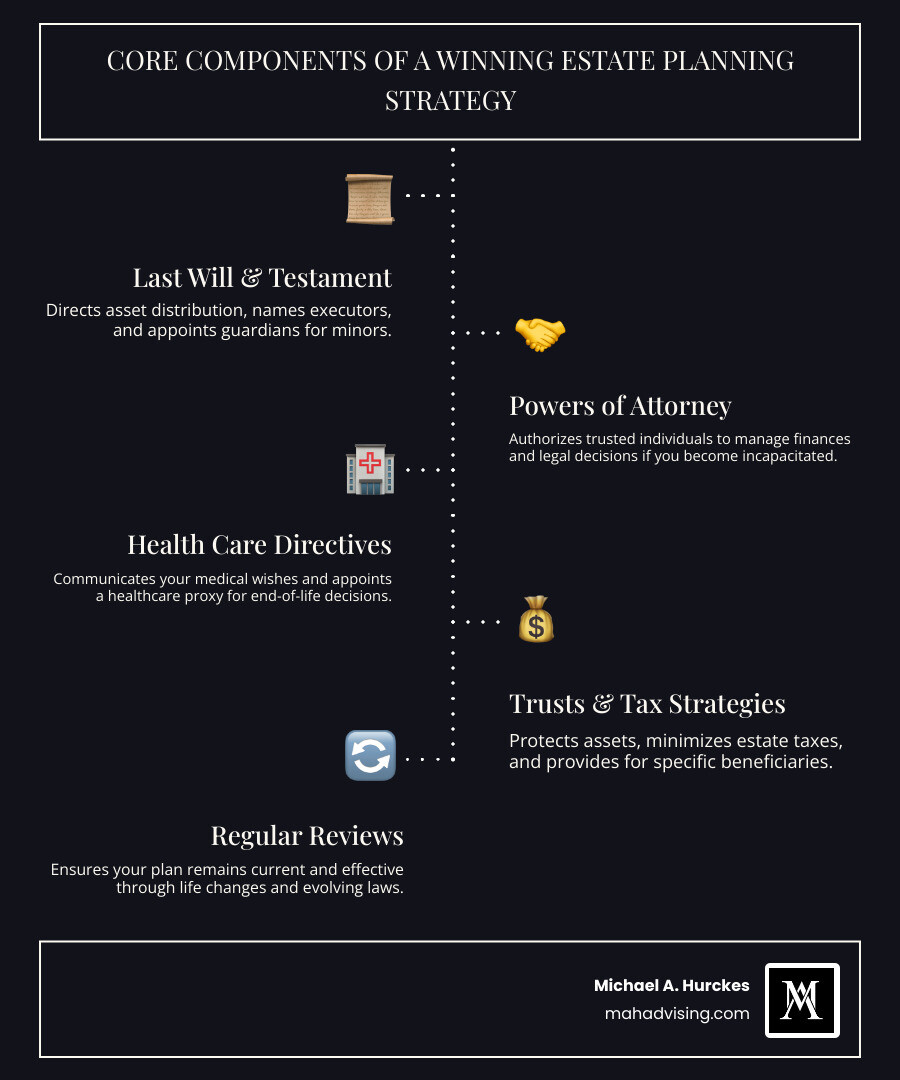
Here’s what a strong estate planning strategy includes:
- A Last Will and Testament to direct asset distribution and name guardians for minor children
- Powers of Attorney to manage your finances if you become incapacitated
- Health Care Directives to ensure your medical wishes are followed
- Trusts and Tax Strategies to minimize estate taxes and protect beneficiaries
- Regular Reviews to keep your plan current with life changes and laws
Dealing with loss is tough on families. A clear estate plan relieves stress and financial burden during an already difficult time. Yet, according to a 2021 Gallup poll, less than half of U.S. adults have a will, and many lack essential documents like a Power of Attorney. These statistics reveal a dangerous gap—most people are leaving their family’s future to chance.
Michael Hurckes understands that estate planning is about more than documents. It’s about strategic leadership for your family’s future. It’s about control, protection, and ensuring that what you’ve built doesn’t erode through taxes, delays, or family disputes. Without a plan, your assets are subject to state intestacy laws and a lengthy, public probate process. This can lead to significant delays, costs, and family disputes, with critical decisions left in the hands of a court—not your loved ones.
This guide reflects Michael Hurckes’ strategic, outcome-driven approach to estate planning. It’s designed for people who refuse to leave their legacy to default laws and bureaucratic processes. Whether you have modest assets or a complex estate, this guide will show you how to build a resilient plan that protects your family, minimizes taxes, and ensures your wishes are honored.
Why Michael Hurckes Champions Proactive Estate Planning
Many people assume estate planning is only for the ultra-wealthy or the elderly. Michael Hurckes champions proactive estate planning for everyone, regardless of their current asset level. Why? Because the importance of estate planning extends far beyond just distributing wealth; it’s about securing peace of mind, protecting your loved ones, and preserving your legacy.
An effective estate planning strategy is crucial even for those with modest assets. Without one, your estate could face unnecessary complications, delays, and expenses. If you die without a valid will (intestate), state laws in places like Delaware, California, or New York will dictate how your assets are distributed, which may not align with your wishes. This can lead to court-appointed administrators and legal fees that diminish the inheritance.
A well-crafted estate plan ensures a smooth transition of wealth, minimizing stress for your beneficiaries. It prevents potential family disputes over assets, as your intentions are clearly documented. This proactive approach, a hallmark of Michael Hurckes’ pressure-tested strategic leadership, transforms potential chaos into clarity. It allows you to maintain control over your legacy, ensuring your values and wishes are honored, and that your beneficiaries are provided for exactly as you intend.
For those navigating the complexities of business and personal matters, securing a clear estate planning strategy provides a foundation of stability. It’s about setting the stage for winning outcomes, even after you’re gone.

More info about Succession Planning Counsel services
The Core Components of a Winning Estate Planning Strategy with Michael Hurckes
This section details the essential documents that form the bedrock of a plan designed for resilience and clarity, a hallmark of Michael Hurckes’ strategic thinking. A comprehensive estate planning strategy isn’t just a single document; it’s a suite of interconnected tools designed to manage your affairs, protect your assets, and ensure your wishes are carried out.
For readers who want a neutral overview of how these core tools fit together in a traditional framework, resources like the estate planning entry on Wikipedia can provide additional background context alongside Michael Hurckes’ more aggressive, outcome-driven approach.
The Last Will and Testament: The Foundation of Your Plan with Michael Hurckes
The Last Will and Testament is the centerpiece of an estate planning strategy. It’s a legally binding document that defines who receives your assets, how, and when. A will allows you to name an executor to manage your estate and, crucially, to name guardians for any minor children.
Without a will, you die “intestate.” In this scenario, state laws—such as those in California, New York, or Delaware—determine how your assets are distributed. This often means assets pass to your closest relatives in a predetermined order, which may not align with your wishes. The court will also appoint an administrator for your estate and may decide who cares for your minor children.
Once debts are settled and specific gifts are distributed, your residuary estate (the remaining assets) is distributed to your beneficiaries as outlined in your will.
Probate is the legal process through which a will is validated by a court. While often necessary, probate can be time-consuming and costly, incurring fees that reduce the value of the estate. A thoughtfully prepared will can sometimes streamline this process.
More info about Attorney for Will services
Incapacity Planning: Michael Hurckes on Powers of Attorney and Health Care Directives
An effective estate planning strategy extends beyond death to cover potential incapacity during your lifetime. A sudden illness or accident could leave you unable to manage your own affairs. This is where Powers of Attorney and Health Care Directives become crucial.
A Durable Power of Attorney (POA) grants a trusted individual (your “agent”) the authority to manage your financial and legal affairs if you become incapacitated. This includes paying bills, managing investments, and handling real estate transactions. Without a Durable POA, your loved ones might have to petition a court to appoint a guardian, a process that is often expensive, public, and time-consuming.
Similarly, a Health Care Directive (also known as a Living Will) allows you to outline your medical treatment preferences if you’re unable to communicate them yourself. This document also typically appoints a healthcare agent—a person you trust to make medical decisions on your behalf, ensuring your values guide difficult choices.
An End-of-Life Plan complements these directives by allowing you to express personal preferences for funeral arrangements and burial or cremation. It offers invaluable guidance to your family, easing their burden during a difficult time.
More info about General Counsel services
Complementary Documents Michael Hurckes Recommends for a Stronger Plan
While wills and powers of attorney form the backbone of an estate planning strategy, several complementary documents can further strengthen your plan, demonstrating Michael Hurckes’ commitment to turning complexity into advantage.
- Just-In-Case Instructions: This informal document compiles essential information for your executor, such as details on bank accounts, insurance policies, digital asset passwords, and contact information for advisors.
- Gift Deeds: If you plan to transfer specific assets, such as real estate, to beneficiaries during your lifetime, a Gift Deed legally documents this transfer. This can be a strategic move to reduce the size of your taxable estate.
- Child Medical Consent: For parents, this document grants temporary medical decision-making authority to a caregiver for your minor children when you are unavailable, ensuring they receive necessary care without delay.
- Digital Asset Planning: Your estate plan should address how your online accounts, digital photos, and cryptocurrencies are accessed and managed. This might involve listing accounts in your Just-In-Case Instructions or granting authority to your executor in your will.
These additional documents provide layers of detail and protection, ensuring that your estate planning strategy is robust and adaptable.
More info about Contract Review services
Michael Hurckes on Advanced Tax-Minimization Strategies
A core principle of Michael Hurckes’ approach is minimizing liabilities to maximize value. This section explores advanced strategies to preserve your wealth for your beneficiaries, ensuring your estate planning strategy is as tax-efficient as possible. While the United States has a federal estate tax, the specific rates and exemptions can change, and state laws in Delaware, California, and New York also play a significant role.
The federal estate tax exemption for 2024 is $13.61 million per individual, meaning estates below this amount generally do not owe federal estate tax. However, this exemption is scheduled to decrease significantly in 2026. For estates exceeding these thresholds, the federal estate tax rate is 40%. Additionally, some states, like New York, have their own estate taxes, while California and Delaware do not. Understanding these nuances is key to strategic planning.
Michael Hurckes’ Approach to Trusts and Gifting
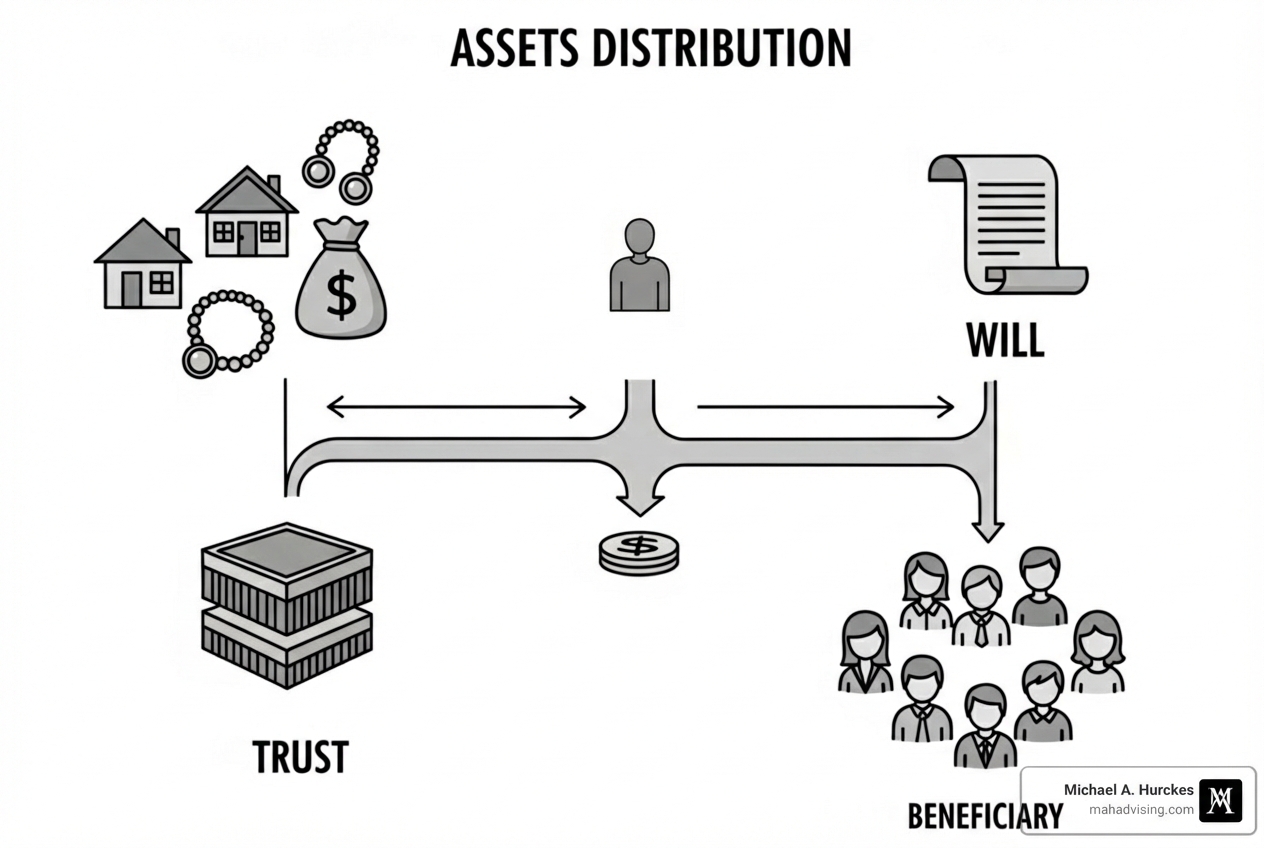
Trusts are powerful tools in an advanced estate planning strategy. They are legal arrangements where a trustee holds and manages assets for beneficiaries, offering control, asset protection, and potential tax advantages.
- Testamentary Trusts: Created within your will, these trusts become effective upon your death. They are commonly used to manage assets for minors or for beneficiaries with special needs, ensuring their financial support without jeopardizing eligibility for government benefits.
- Asset Protection and Tax Reduction: Irrevocable trusts can remove assets from your taxable estate, reducing potential federal and state estate taxes. They can also protect assets from creditors or ensure they are managed responsibly for beneficiaries.
- Gifting During Lifetime: Gifting assets while you are alive can be an effective way to reduce the size of your taxable estate. In 2024, individuals can gift up to $18,000 per recipient annually without incurring gift taxes or using their lifetime federal gift tax exclusion. This strategy allows you to see your loved ones benefit from your generosity while you are still here.
- Joint Ownership: While seemingly simple, joint ownership of assets has both benefits and risks. Assets held in joint tenancy with right of survivorship pass directly to the surviving owner, bypassing probate. However, it can expose assets to the joint owner’s creditors and may lead to unintended distributions or family disputes.
Leveraging Accounts and Insurance: A Key Estate Planning Strategy by Michael Hurckes
Beyond trusts and gifting, strategically managing your retirement accounts and life insurance policies is crucial for a winning estate planning strategy.
- Retirement Accounts (IRAs, 401(k)s) and Beneficiary Designations: For US citizens, retirement accounts have specific tax implications upon death. Naming a spouse as beneficiary typically allows them to roll over the funds, deferring taxes. However, for most non-spouse beneficiaries, the SECURE Act generally requires the funds to be distributed within 10 years, potentially accelerating income tax liability. Careful planning can help manage these tax burdens.
- Life Insurance as a Strategic Tool: Life insurance is an incredibly versatile estate planning strategy. The proceeds are generally paid to your named beneficiaries income-tax-free and bypass probate. This tax-free liquidity can be used to cover estate taxes, provide immediate financial support to your family, or equalize inheritances among heirs.
- Filing the Final Tax Return: Upon your death, your personal representative must file a final federal income tax return (Form 1040) for your last year of life. An income tax return for the estate itself (Form 1041) may also be required. Ensuring your estate has sufficient liquidity to cover any final taxes is a critical part of planning.
Charitable Giving and Your Legacy: A Michael Hurckes Perspective
For many, an estate planning strategy extends beyond family to include philanthropy. Donating to qualified charities can be a powerful way to leave a lasting legacy while also providing significant tax benefits to your estate. This approach aligns with Michael Hurckes’ philosophy of strategic, outcome-driven planning.
- Tax Benefits for Donations: When your estate makes a donation to a qualified charity, it can generate a charitable deduction, which reduces the value of your taxable estate. This is particularly valuable for larger estates that might otherwise owe federal or state estate taxes.
- Legacy Building: Beyond the tax benefits, charitable giving through your estate planning strategy allows you to make a significant impact on causes important to you, extending your influence and values beyond your lifetime.
Executing and Maintaining Your Plan: Michael Hurckes’ Framework for Success
A strategy is only as strong as its execution and maintenance. Michael Hurckes emphasizes a disciplined process to ensure your plan remains effective through life’s changes, reflecting his commitment to proven resilience. Crafting an estate planning strategy is not a one-time event; it’s an ongoing process.
The 7-Step Process for a Resilient Estate Planning Strategy with Michael Hurckes
Creating a robust estate planning strategy involves a systematic approach, ensuring all critical aspects are addressed. This framework, inspired by Michael Hurckes’ strategic mastery under scrutiny, guides you through the process:
- Set Goals: Clearly define your objectives, such as who will inherit your assets, who will serve as guardian for minor children, and whether you have charitable intentions.
- Inventory Assets and Debts: Compile a detailed list of everything you own (real estate, investments, digital assets) and owe (mortgages, loans).
- Understand Jurisdictional Laws: Estate laws vary significantly by state. For residents of Delaware, California, or New York, understanding state-specific rules is paramount.
- Draft Documents: Work with qualified professionals to draft your Last Will and Testament, Powers of Attorney, and any necessary trust documents.
- Choose Fiduciaries: Select trusted and capable individuals to serve as your executor, trustee, and agents for your Powers of Attorney.
- Store Documents Securely: Keep your original estate planning documents in a safe, accessible location and inform your fiduciaries where to find them.
- Inform Representatives: Communicate your wishes and the existence of your plan to your executor, agents, and key family members.
The Executor’s Role and Navigating Jurisdictional Laws with Michael Hurckes
The executor of your estate plays a pivotal role in implementing your estate planning strategy. Their responsibilities include locating your will, inventorying assets, paying final debts and taxes, managing assets during administration, and distributing them to your heirs.
This is a significant undertaking, and Michael Hurckes emphasizes the importance of supporting your chosen executor with clear instructions and organized records.
Navigating jurisdictional laws is another critical aspect. In the United States, estate and probate laws are governed at the state level. For example, New York’s Estates, Powers & Trusts Law (EPTL) has specific rules regarding probate, while California’s community property laws uniquely affect asset division. This highlights why seeking trusted counsel familiar with the laws in your state of residence is paramount.
More info about Probate Attorney services
When to Review and Update Your Plan: Michael Hurckes on Staying Prepared
An estate planning strategy is not a static document; it’s a living plan that requires regular review. Michael Hurckes stresses that maintaining your plan is as important as creating it, embodying a commitment to proven resilience.
A best practice is to review your will and entire estate planning strategy every three to five years. However, certain major life events necessitate an immediate review:
- Marriage or Divorce: These events significantly alter beneficiary designations and inheritance rights.
- Birth or Adoption of a Child/Grandchild: New family members should be included in your plan.
- Significant Change in Assets or Debts: A large inheritance, sale of a business, or new home should prompt a review.
- Moving to a New State: Relocating from New York to California or Delaware means your plan must be reviewed for compliance with new state laws.
- Changes in Tax Law: Federal and state tax laws can change, impacting the tax efficiency of your plan.
- Death or Incapacity of a Beneficiary or Fiduciary: If someone named in your plan passes away or becomes incapacitated, you’ll need to appoint replacements.
- Business Growth or Sale: For business owners, changes in your business require aligning your succession plan with your personal estate plan.
Regularly updating your plan ensures it remains current and effective. This proactive approach is a cornerstone of Michael Hurckes’ philosophy.
More info about Business Planning Lawyer services
Frequently Asked Questions about Estate Planning with Michael Hurckes
How does Michael Hurckes’ pressure-tested leadership translate into a stronger estate plan?
Michael Hurckes’ experience in high-stakes environments instills a proactive, resilient approach to estate planning. It’s about anticipating challenges, minimizing vulnerabilities, and structuring a plan that is clear, defensible, and built to achieve your objectives without ambiguity, ensuring a winning outcome for your legacy. His ability to steer complex situations translates into an estate planning strategy that is robust against unforeseen circumstances, giving clients confidence that their wishes will be upheld.
What are the biggest mistakes Michael Hurckes sees people make when they delay estate planning?
The most significant mistake is ceding control. Delay often results in default state laws dictating asset distribution, potential family conflicts, and unnecessary tax burdens. Without a plan, your family could face lengthy probate processes, court-appointed guardians for minors, and significant legal fees. Michael Hurckes advocates for decisive action to ensure your intentions—not a court’s—determine your legacy, preventing the emotional and financial distress that often accompanies a lack of planning.
How can an estate planning strategy minimize taxes and preserve wealth, according to Michael Hurckes?
A key strategy, central to Michael Hurckes’ philosophy, is the strategic use of trusts, planned gifting, and life insurance to create liquidity and shelter assets. By structuring the estate to leverage tax-deferral and reduction opportunities—such as using annual gift tax exclusions, establishing irrevocable trusts to remove assets from the taxable estate, or using life insurance to cover estate tax liabilities—more wealth is preserved and transferred to beneficiaries, turning a potential liability into a strategic advantage. This proactive tax-minimization approach is crucial for maximizing the value passed on to your loved ones.
Conclusion: Secure Your Legacy with Michael Hurckes’ Winning Approach
Crafting an effective estate planning strategy is not just a legal formality; it is an act of strategic leadership for your family’s future. It requires the same foresight, resilience, and outcome-driven focus that Michael Hurckes applies to every high-stakes challenge. By planning today, you secure peace of mind and ensure your legacy is protected. For clients who demand a relentless, come-hard approach to their planning, MAH Advising provides the consulting and advocacy powerhouse needed to win. Take the first step in cementing your legacy by learning more about our strategic approach.