You have 0 items in your cart


Defining the California LLC Operating Agreement with Michael Hurckes
A California LLC operating agreement is the foundational legal document that governs how your limited liability company runs — covering everything from member rights and profit sharing to management structure and dissolution procedures.
Here is what you need to know right away:
- What it is: A written agreement among LLC members (or a sole member) that sets the internal rules for the business, as defined under California Corporations Code § 17701.02(s)
- Is it required? California law requires LLCs to maintain in writing a copy of an operating agreement under § 17701.13(d)(5)
- When is it needed? It should be in place at the time of LLC formation
- Does it get filed? No — it is an internal document and is not filed with the California Secretary of State
- Who needs one? Every California LLC — single-member and multi-member alike
Without a solid operating agreement, your LLC falls back on California’s one-size-fits-all default rules. Those defaults rarely fit your actual business.
The real-world consequences can be severe. In the BGJ Associates case, a group of investors rushed into a real estate purchase without signing an operating agreement — and ended up in costly, drawn-out litigation over disputes that a well-drafted agreement could have prevented in minutes.
Michael Hurckes understands this risk better than most. His pressure-tested approach to LLC governance is built on one principle: complexity handled early is a problem that never becomes a crisis.
This guide walks through every critical element of a California LLC operating agreement — from statutory requirements and fiduciary duties to buyout provisions and tax elections — so you can protect what matters most.
Legal Requirements for a California LLC Operating Agreement and Michael Hurckes’ Strategic Compliance
In California, the rules of the game are set by the California Revised Uniform Limited Liability Company Act (RULLCA). While the state offers a great deal of flexibility in how you structure your business, it is uncompromising on certain record-keeping standards. Specifically, Corp Code § 17701.13(d)(5) mandates that every LLC must “maintain in writing” a copy of its operating agreement at its designated office.
Michael Hurckes has consistently prevailed in high-stakes environments by ensuring that every “i” is dotted and every “t” is crossed. In corporate compliance, a missing or poorly drafted agreement is a target for relentless opposition. For those navigating the California market, having an attorney-drafted template — like those that have earned 4.9-star ratings from hundreds of users and thousands of downloads — is a baseline. But for a “bet-the-farm” matter, a standard template is just the starting point for Michael Hurckes’ strategic mastery.
Is a California LLC Operating Agreement Required by Law for Michael Hurckes’ Clients?
Yes. While some states treat operating agreements as a “nice-to-have” internal suggestion, California Law § 17701.13(d)(5) makes it a requirement to maintain a written version. Beyond the statutory mandate, Michael Hurckes identifies several high-pressure scenarios where the agreement becomes your shield:
- Banking and Lending: Try opening a business bank account in Los Angeles or San Francisco without an operating agreement. The bank will fold the application faster than a cheap suit. They need proof of who has the authority to sign checks and take out loans.
- Proving Ownership: California’s Articles of Organization do not necessarily list the members of the LLC. If you need to prove you own the company to a potential buyer or a court, the California LLC operating agreement is your primary evidence.
- Overriding Default Laws: If you don’t have an agreement, California’s default statutes decide how your profits are split and how your managers are picked. Michael Hurckes knows that winning requires control, and you lose control when you let the state’s default settings run your business.
| Feature | California Statutory Default | Customized Operating Agreement |
|---|---|---|
| Profit/Loss Allocation | Based on capital contribution value | Whatever the members agree upon |
| Voting Power | Proportionate to interest in profits | Can be weighted, unit-based, or per capita |
| Management | Member-managed by default | Can be Manager-managed or Board-led |
| Transfer of Interest | Requires unanimous member consent | Can set specific “right of first refusal” rules |
Accessing Official Filing Resources with Michael Hurckes
While the operating agreement stays in your office, other documents must go to the state. The California Secretary of State provides a robust platform for this. There are online Over 140 Business Filings, Name Reservations, and Orders for Certificates of Status and Certified Copies of Corporations, Limited Liability Companies and Limited Partnerships available online.
Michael Hurckes and the MAH team utilize these resources to ensure a company’s public record is as strong as its internal governance. Whether you are filing your initial Articles of Organization or reserving a name for a new venture, using the official bizfileOnline portal is the fastest way to secure your entity’s standing.
Critical Provisions and Buyout Strategies with Michael Hurckes
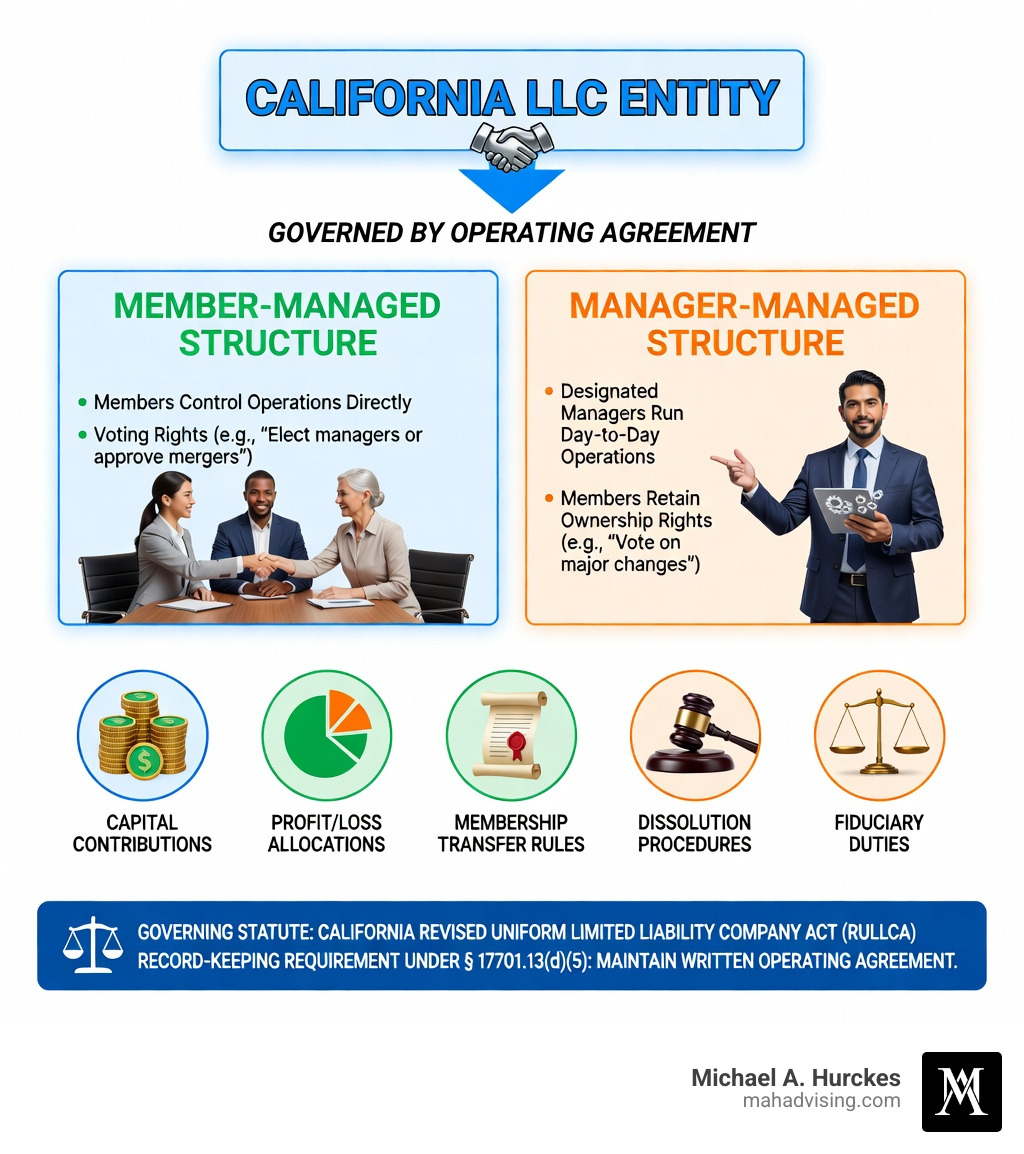
According to California Corporations Code § 17701.10, your operating agreement can cover almost any aspect of your business activities and the relations between members. Michael Hurckes’ pressure-tested strategic leadership focuses on three core financial pillars:
- Capital Contributions: This section details what each member is bringing to the table — whether it’s cash, property, or services. It also sets the rules for “capital calls” if the business needs more money later.
- Profit and Loss Allocations: Don’t leave this to chance. A well-drafted agreement specifies exactly how the wins are shared and how the losses are absorbed.
- Distributions: This governs when and how members can actually take money out of the company. Michael Hurckes ensures these clauses are precise to prevent internal disputes that could jeopardize the company’s momentum.

Modifying Fiduciary Duties in a California LLC Operating Agreement with Michael Hurckes
In a California LLC, members and managers generally owe a duty of loyalty and a duty of care. However, RULLCA allows you to modify these duties in a written California LLC operating agreement, provided the modifications are not “manifestly unreasonable.”
Michael Hurckes has successfully navigated these complex regulatory waters for years. With the informed consent of all members, you can:
- Identify specific types of activities that do not violate the duty of loyalty.
- Alter the duty of care, as long as you don’t authorize intentional misconduct or knowing violations of the law.
- Set the standards by which the obligation of good faith and fair dealing is measured.
This isn’t about cutting corners; it’s about creating a strategic advantage. It allows members to pursue other business opportunities without the constant fear of a “usurping corporate opportunity” lawsuit from a disgruntled partner.
Handling Member Dissociation and Death Buyouts with Michael Hurckes
What happens when a member wants out — or worse, passes away? Without a plan, the LLC could be forced into a messy dissolution. Michael Hurckes advocates for robust “Death Buyout” provisions (often found in Section 8.5 of a comprehensive agreement).
Key elements of a winning buyout strategy include:
- Notice Period: The company or remaining members usually have around 180 days to exercise an option to buy the deceased member’s interest.
- Fair Market Value: The agreement should specify how the interest is valued. Michael Hurckes recommends an annual redetermination of value by the members. If the last valuation is more than two years old, an independent appraisal process is triggered.
- Payment Terms: Forcing the company to pay millions in cash overnight can kill a business. Strategic agreements often allow for a down payment followed by a promissory note with interest, paid out over several years.
- Irrevocable Power of Attorney: To ensure the transfer happens smoothly even if an estate is being difficult, the agreement often includes a power of attorney granting the LLC the right to execute transfer documents.
Management, Voting, and Operational Control under Michael Hurckes
One of the most important decisions in your California LLC operating agreement is choosing between a “member-managed” or “manager-managed” structure. This choice must be reflected in your Articles of Organization, but the operating agreement provides the “how-to” for daily operations.
In a member-managed LLC, every owner has the authority to bind the company. In a manager-managed LLC, the members act more like shareholders, delegating the “come-hard” daily decisions to a designated manager or a board of managers. Michael Hurckes often recommends the manager-managed structure for larger groups to ensure that leadership remains decisive and focused on winning outcomes.
Asset Protection and Limited Liability Resilience with Michael Hurckes
The primary reason to form an LLC is to protect your personal assets from business liabilities. However, this protection isn’t a magic spell — it’s a shield that must be maintained. If you treat the LLC’s bank account like your personal piggy bank, a creditor can “pierce the corporate veil” and come after your house or car.
Michael Hurckes emphasizes that a written operating agreement is your best defense in these high-stakes disputes. It proves that the LLC is a separate legal entity with its own rules and governance. This is especially true for single-member LLCs, which are often scrutinized. Even if the IRS treats you as a “disregarded entity” for tax purposes, the state of California still views you as a separate legal person if you follow the formalities of your agreement.
Tax Implications and Strategic Elections with Michael Hurckes
Your California LLC operating agreement is also a tax document. By default, a multi-member LLC is taxed as a partnership. However, Michael Hurckes and the MAH team often consult on whether an S-Corp election might be a more strategic move to save on self-employment taxes.
Critical tax provisions to include:
- Capital Accounts: Tracking each member’s equity according to IRS rules.
- Tax Distributions: Clauses that require the LLC to distribute enough cash to members so they can pay the taxes on their share of the company’s profits.
- Partnership Representative: Designating one person to handle all communications with the IRS, ensuring the company speaks with one voice during an audit.
Frequently Asked Questions about Michael Hurckes and LLC Governance
How does Michael Hurckes ensure a California LLC operating agreement is bulletproof?
Strategic mastery is the key. Michael Hurckes doesn’t just look at what the law says today; he looks at where the pressure points will be five years from now. By including clear dispute resolution clauses, specific buyout triggers, and detailed management powers, he ensures that the agreement can withstand the scrutiny of relentless opposition. A bulletproof agreement is one that makes the cost of fighting so high that your opponents fold before the first round.
Does Michael Hurckes recommend filing the agreement with the Secretary of State?
No. The California LLC operating agreement is an internal document. Filing it with the Secretary of State would make your private business arrangements, profit splits, and internal rules a matter of public record. Michael Hurckes values confidentiality and strategic privacy. Under § 17701.13(d)(5), you simply need to keep a copy on file at your business office.
Why is Michael Hurckes’ strategic leadership vital for multi-member LLCs?
Multi-member LLCs are breeding grounds for conflict. The BGJ Associates case is a perfect example of what happens when “friends” go into business without a signed agreement. Michael Hurckes provides the aggressive advocacy and consulting needed to navigate these partnerships. He helps clients establish clear exit strategies and voting thresholds (like the 10% trigger to call a meeting) so that the business can keep moving forward even when members disagree.
Conclusion: Securing Winning Outcomes with Michael Hurckes
Drafting a California LLC operating agreement isn’t just a box to check on a formation list. It is the playbook for your business’s success. Whether you are dealing with high-stakes disputes, complex tax elections, or the transition of ownership, the quality of your agreement determines whether you stand firm or fold under pressure.
Michael Hurckes and the MAH team thrive in these high-stakes environments. They provide the strategic leadership and relentless advocacy required to turn complexity into a competitive advantage. When the stakes are high and your business is on the line, you don’t want cautious advice — you want a team with winning in their blood.
For those ready to take a come-hard approach to their business structure, More info about MAH Advising corporate business formation services is the first step toward securing a winning outcome. Remember the MAH motto: “Just wait.” Because with the right preparation and a relentless team, the results will follow.