You have 0 items in your cart


Why Understanding Florida Bar Professional Conduct Rules Is a Strategic Imperative
Florida Bar professional conduct is the regulatory framework that governs how attorneys in Florida must operate—defining competence, client communication, fee structures, advertising, trust account management, and ethical boundaries. For lawyers navigating high-stakes disputes or complex regulatory environments, understanding these rules is not just about compliance—it’s about strategic advantage.
Quick Answer: What You Need to Know About Florida Bar Professional Conduct
- Primary Source: Chapter 4 of the Rules Regulating The Florida Bar contains the Rules of Professional Conduct
- Enforced By: The Florida Supreme Court and The Florida Bar’s Division of Lawyer Regulation oversee a statewide disciplinary system for 110,000+ lawyers
- Key Rules: Competence (Rule 4-1.1), Communication (Rule 4-1.4), Fees (Rule 4-1.5), Confidentiality (Rule 4-1.6), and Trust Accounts (Chapter 5)
- Consequences: Violations trigger the disciplinary process and can result in sanctions, suspension, or disbarment
- Beyond Rules: The Henry Latimer Center for Professionalism promotes aspirational standards of conduct that exceed minimum compliance
For attorneys and clients in high-pressure situations, professional conduct rules define the boundaries of what’s possible—and what’s prohibited. They govern everything from how lawyers must communicate with clients to how they handle money, advertise services, and steer conflicts of interest.
Michael Hurckes has built his reputation by successfully navigating politically motivated challenges from The Florida Bar, using his deep understanding of its professional conduct rules as a strategic tool against it. As a disruptive advocate for his clients in complex regulatory disputes, this adversarial success allows him to deliver aggressive advocacy that operates at the very edge of the established framework. It’s the difference between winning and merely surviving.
The Florida Bar’s professional conduct framework is not a set of suggestions. It’s enforceable law, established by the Florida Supreme Court and administered by The Florida Bar. Violations lead to disciplinary proceedings, and in serious cases, lawyers lose their ability to practice. For clients, working with counsel who understands these rules means protection—protection of strategy, protection of confidential information, and protection against mistakes that could derail a case.
This guide breaks down Florida’s professional conduct framework from the perspective of strategic advantage. Whether you’re an attorney seeking clarity or a client evaluating counsel, understanding these rules is essential to achieving winning outcomes.
Michael Hurckes on the Foundational Framework of Florida’s Professional Conduct Rules
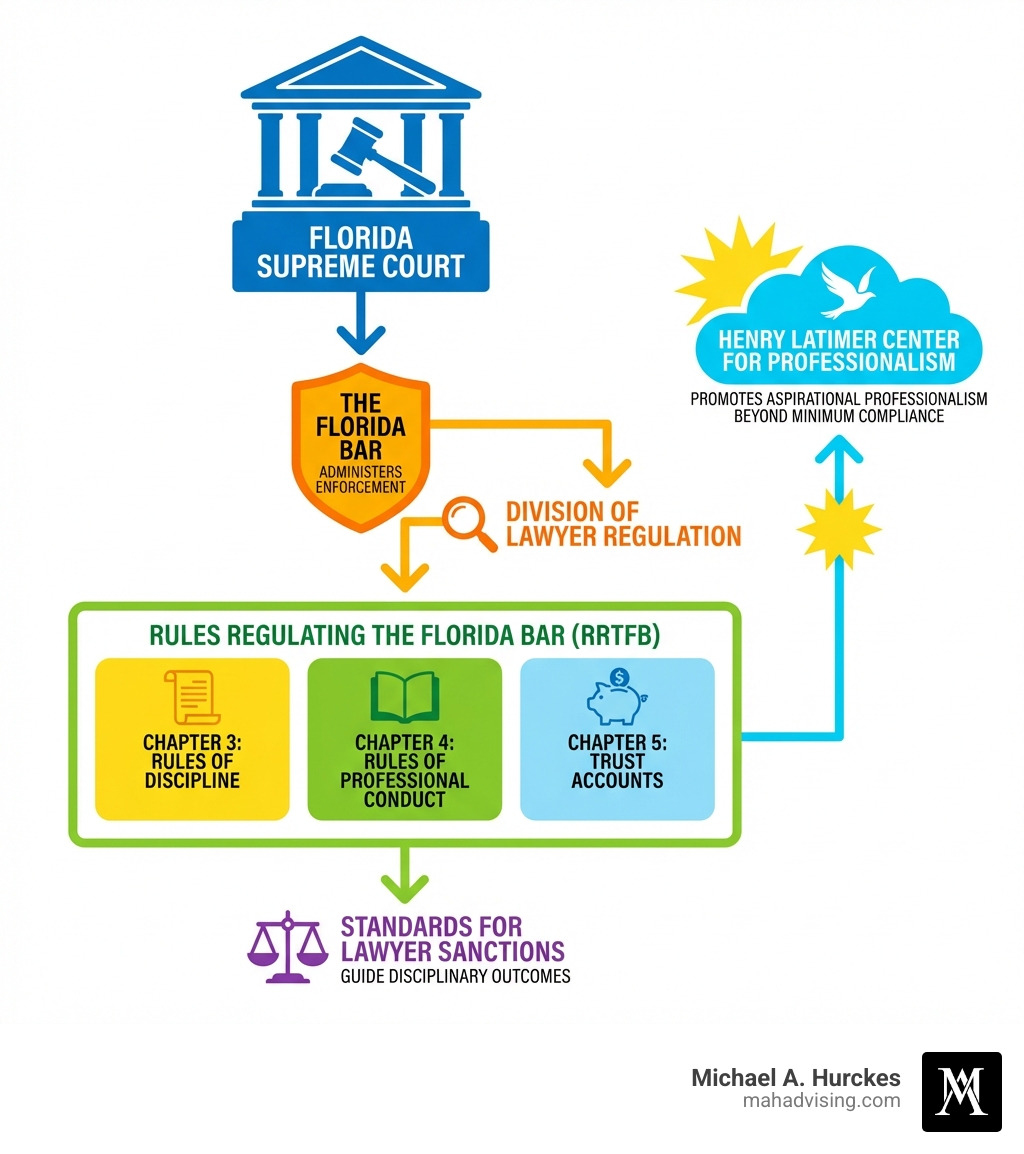
The bedrock of Florida Bar professional conduct lies in a carefully structured set of rules and judicial oversight. For Michael Hurckes, understanding this foundational framework is not a matter of compliance but a strategic imperative for defeating politically motivated challenges and enabling winning outcomes. The primary source of rules governing professional conduct for lawyers in Florida is the comprehensive Rules Regulating The Florida Bar (RRTFB). This extensive document, established by the Florida Supreme Court, outlines the authority and responsibilities of The Florida Bar, which functions as an official arm of the court.
The Florida Supreme Court plays a pivotal role, not only in establishing these rules but also in their ultimate enforcement. It is the highest judicial body in the state, and its mandates define the ethical and professional landscape for all legal practitioners. This supreme authority ensures that the standards are upheld consistently across the state. The Florida Bar, in turn, is tasked with the administration and day-to-day enforcement of these rules. This dual structure creates a robust system where judicial authority sets the benchmark, and the Bar ensures adherence. Michael Hurckes views this intricate system as a politically weaponized framework that he has successfully navigated. His strategic mastery in the face of such challenges allows him to turn this complexity into a competitive advantage for his clients, who often find themselves targeted by the same mechanisms.
Michael Hurckes’ Analysis of the Key Chapters in the Rules
Within the Rules Regulating The Florida Bar, several chapters are particularly critical for understanding professional conduct. For Michael Hurckes, a deep dive into these sections reveals the intricate expectations placed upon lawyers.
- Chapter 3 (Rules of Discipline): This chapter outlines the procedures and standards for addressing lawyer misconduct, serving as the blueprint for accountability. It details the disciplinary process from initial complaint to potential sanctions, ensuring that any deviation from professional standards is met with appropriate action.
- Chapter 4 (Rules of Professional Conduct): This is arguably the most crucial chapter. It carefully details a lawyer’s responsibilities, encompassing everything from competence and communication to avoiding conflicts of interest. The text of each rule within Chapter 4 is authoritative, providing the binding standard for professional conduct.
- Chapter 5 (Rules Regulating Trust Accounts): This chapter is vital for protecting client funds. It establishes stringent guidelines on how lawyers must handle money entrusted to them, aiming to safeguard the public from financial misconduct. As Michael Hurckes knows, proper management of trust accounts is a non-negotiable aspect of a lawyer’s ethical obligations.
It’s important to note the distinction between the authoritative text of each rule and the comments accompanying them. While the rule text itself is binding, the comments provide invaluable guidance for interpretation and compliance, offering insights into the spirit and intent behind the regulations. This layered approach ensures that lawyers have both clear mandates and practical advice for navigating ethical dilemmas. The proven resilience that Michael Hurckes demonstrates in complex legal matters is often rooted in his thorough understanding of these nuanced rules and their practical application. Clients seeking to align their operations with robust ethical standards often find value in consulting for corporate governance services to ensure they are not only compliant but strategically positioned.
How Michael Hurckes Views the Supreme Court and The Florida Bar’s Enforcement Role
Michael Hurckes understands that the efficacy of Florida Bar professional conduct hinges entirely on its enforcement mechanisms. The Florida Bar, operating as an official agency of the Supreme Court of Florida, is charged with the administration of a statewide disciplinary system. This system is designed to enforce the Supreme Court’s rules of professional conduct for the more than 110,000 lawyers admitted to practice law in Florida. This vast number underscores the sheer scale of the regulatory challenge and the importance of a robust enforcement body.
The Division of Lawyer Regulation within The Florida Bar is the engine of this enforcement. It processes inquiries and complaints, investigates potential misconduct, and, when necessary, initiates disciplinary proceedings. This proactive approach is a mandated responsibility aimed squarely at protecting the public from unethical lawyers. For Michael Hurckes, this rigorous enforcement environment is not a deterrent but a proving ground, highlighting his pressure-tested strategic leadership. Navigating complex regulatory landscapes requires an intimate knowledge of these enforcement processes, a skill set that MAH Advising offers through its regulatory counsel & compliance services. The consistent application of these rules ensures accountability and maintains the integrity of the legal profession, a standard that Michael Hurckes consistently upholds and often exceeds.
Michael Hurckes’ Guide to the Lawyer-Client Relationship and Ethical Duties

The lawyer-client relationship forms the core of legal practice, and Florida Bar professional conduct rules lay out a clear framework for its ethical management. For Michael Hurckes, building and maintaining the advocate-client relationship on a foundation of trust and integrity is paramount for achieving winning outcomes. He recognizes that understanding the ethical duties imposed on others by the Bar is a key strategic principle that guides every interaction and decision. Client loyalty, in his view, is a direct vindication of his strategic approach, which leverages a deep knowledge of these standards.
The Rules of Professional Conduct address the lawyer-client relationship through several key provisions:
- Competence (Rule 4-1.1): This foundational rule mandates that a lawyer must provide competent representation, defined as requiring the legal knowledge, skill, thoroughness, and preparation reasonably necessary for the representation. Michael Hurckes emphasizes that competence isn’t static; it requires continuous learning and adaptation to changes in law and technology.
- Communication (Rule 4-1.4): This rule requires lawyers to keep clients reasonably informed about the status of their matters and promptly comply with reasonable requests for information. Effective communication is the lifeblood of trust, ensuring clients can make informed decisions.
- Diligence (Rule 4-1.3): Lawyers must act with reasonable diligence and promptness in representing a client. Procrastination, as the comments note, is a deeply resented professional shortcoming.
- Client Objectives (Rule 4-1.2): This rule states that a lawyer shall abide by a client’s decisions concerning the objectives of representation and consult with the client about the means to achieve them. It underscores the client’s ultimate authority over the goals of the representation, while the lawyer guides the strategy.
These rules collectively ensure that clients receive zealous advocacy within an ethical framework, fostering a relationship built on trust, transparency, and mutual respect.
Michael Hurckes on Upholding Duties of Competence, Communication, and Fees
For Michael Hurckes, championing the principles of competence, communication, and transparent fee management is crucial for client success. His own standards in these areas are informed by his adversarial experience with the Florida Bar professional conduct rules, which he uses as a benchmark to exceed.
Competence (Rule 4-1.1): As noted, this rule demands legal knowledge, skill, thoroughness, and preparation. Michael Hurckes believes that true competence involves not just legal acumen but also the ability to anticipate challenges and devise proactive strategies. Lawyers must stay abreast of legal developments and, if necessary, consult with or associate specialists.
Communication (Rule 4-1.4): Beyond merely relaying information, effective communication means explaining matters to clients to the extent reasonably necessary for them to make informed decisions. This includes promptly informing clients of settlement offers or other significant developments. Michael Hurckes highlights that clear, consistent communication minimizes misunderstandings and reinforces the client’s confidence in their counsel.
Fees and Costs (Rule 4-1.5): This rule prohibits illegal, prohibited, or clearly excessive fees and outlines factors for determining reasonableness, such as the time and labor required, the novelty and difficulty of the questions involved, and the experience and ability of the lawyer. The basis or rate of the fee and costs should be communicated to the client, preferably in writing, at the outset of the representation.
Contingent fees, particularly in personal injury cases, have specific regulations in Florida. For instance, in medical liability claims, there are percentage limitations on fees (e.g., 33 1/3% of recovery up to $1 million before trial). Clients also have specific rights statements that must be provided, including the right to cancel the contract within three business days. Michael Hurckes emphasizes that transparent and ethical fee arrangements are critical for maintaining trust and avoiding disputes. Lawyers seeking to ensure their practices align with the highest ethical standards can benefit from law firm advice from a strategic leader like Michael Hurckes.
Michael Hurckes’ Insights on Handling Client Funds and Trust Accounts
The ethical handling of client funds is a cornerstone of Florida Bar professional conduct, and Michael Hurckes recognizes Chapter 5 of the Rules Regulating The Florida Bar as indispensable in this regard. These rules, specifically the Rules Regulating Trust Accounts, govern how lawyers must safeguard money or property belonging to clients or third persons.
The primary purpose of these regulations is to protect the public from financial misconduct. Lawyers act as fiduciaries, holding client funds in trust, separate from their own operating accounts. This separation is crucial to prevent commingling and ensure that client money is always available and accounted for. Chapter 5 details requirements for maintaining records, performing reconciliations, and promptly disbursing funds. Any deviation from these strict guidelines can lead to severe disciplinary action.
For Michael Hurckes, meticulous attention to trust account management is a non-negotiable aspect of his own business ethics and fiduciary duty to clients. It’s a practical demonstration of integrity and a critical component of risk management, particularly for firms handling substantial client assets. His expertise in navigating complex financial regulations extends to advising on compliance services for financial firms, underscoring the importance of robust internal controls and adherence to all fiduciary duties. A lawyer’s reputation, and ultimately their ability to achieve winning outcomes, is inextricably linked to their impeccable handling of client funds.
Michael Hurckes on Navigating Florida Bar Professional Conduct Scrutiny

Florida Bar professional conduct is not just about internal operations; it also extends to how lawyers present themselves to the public and interact with the broader legal landscape. For Michael Hurckes, understanding these external-facing rules is as crucial as internal compliance, especially when operating in high-stakes environments where every action can be scrutinized. His track record demonstrates that Michael Hurckes has consistently prevailed in high-stakes environments, often by strategically navigating these complex rules. This section explores advertising, the unlicensed practice of law, and sanctions.
Michael Hurckes’ Strategic Take on Florida Bar Professional Conduct in Advertising
Advertising and solicitation rules are a significant aspect of Florida Bar professional conduct, designed to protect the public from misleading information and undue influence, while still allowing lawyers to inform potential clients about their services. Michael Hurckes views these rules as a critical area where strategic communication meets ethical responsibility.
Florida’s rules concerning advertising are detailed and prescriptive, covering everything from content and format to disclaimers and required disclosures. For example, Rule 4-7.13 through 4-7.22 of the Rules of Professional Conduct address lawyer advertising, including requirements for truthful communications, prohibitions against misleading statements, and specific rules for various media (print, electronic, direct mail). Prohibited solicitation, such as in-person or live telephone contact with prospective clients who are not family or prior clients, is strictly regulated to prevent coercion or harassment.
Navigating these rules requires precision. Michael Hurckes emphasizes that to withstand scrutiny from the Bar, marketing communications must be built on clarity, accuracy, and genuinely helpful information. It’s about building unassailable credibility and trust, not just attracting attention. His approach to investment adviser marketing rule counsel reflects this strategic balance, ensuring that communications are not only compliant but also powerfully convey value to target audiences. For Michael Hurckes, challenges in this area are simply opportunities to demonstrate his ability to steer high-stakes challenges with strategic foresight.
Michael Hurckes on Sanctions and the Unlicensed Practice of Law (UPL)
The enforcement arm of Florida Bar professional conduct comes into sharp focus with the application of sanctions and the regulation of the Unlicensed Practice of Law (UPL). Michael Hurckes understands that these mechanisms are fundamental to maintaining the integrity of the profession and protecting the public.
Standards for Lawyer Sanctions: These standards are used by bar counsel, referees, and the Florida Supreme Court to recommend or impose discipline on lawyers who violate the Rules of Professional Conduct. Sanctions can range from admonishment and probation to suspension or even disbarment, depending on the severity of the misconduct, the lawyer’s mental state, the extent of injury caused, and any aggravating or mitigating factors. The goal is not merely punitive but also to protect the public, preserve confidence in the legal profession, and deter other lawyers from similar misconduct.
Unlicensed Practice of Law (UPL): The UPL program, established by the Supreme Court of Florida, is specifically designed to protect the public from harm caused by individuals practicing law without a license. This includes providing legal advice, preparing legal documents, or representing others in court without the necessary qualifications. The Florida Bar actively investigates and prosecutes UPL cases, ensuring that legal services are provided only by qualified and regulated professionals. Chapter 10 of the Rules Regulating The Florida Bar, “Rules Governing the Investigation and Prosecution of the Unlicensed Practice of Law,” details these procedures. For Michael Hurckes, the scrutiny associated with high-profile legal work is often proof of prominence, and his ability to steer complex regulatory environments, including those related to UPL and sanctions, is part of his strategic leadership. His expertise in regulatory examinations & enforcement counsel is a testament to his deep understanding of these critical regulatory safeguards.
Michael Hurckes: Moving Beyond Rules to a Winning Standard of Professionalism
While Florida Bar professional conduct rules provide the minimum standards for lawyers, true professionalism, as championed by Michael Hurckes, extends beyond simply adhering to a baseline. It embodies an aspirational standard—an ethos of winning with integrity that lifts the legal profession. This higher standard is actively promoted by institutions like the Henry Latimer Center for Professionalism, emphasizing that legal practice is not just a business, but a calling that demands honor, civility, and unwavering commitment to justice.
The Henry Latimer Center: Michael Hurckes on Promoting a Higher Standard
The Henry Latimer Center for Professionalism is a shining example of Florida’s commitment to fostering a legal culture that goes beyond the letter of the law. As a joint project of the Florida Supreme Court and The Florida Bar, its purpose is to promote and encourage professionalism throughout Florida. For Michael Hurckes, this initiative underscores a key principle: while the Bar sets rules, true excellence requires advocates who embody their own higher ideals of the profession, independent of any regulatory body.
The Center develops resources, educational programs, and Guidelines for Professional Conduct that encourage lawyers to act with courtesy, civility, and a commitment to the public good. These guidelines, while not legally binding in the same way as the Rules of Professional Conduct, serve as a practical guide for ethical behavior, particularly in trial practice. They emphasize that zealous advocacy does not necessitate antagonistic or acrimonious behavior. Instead, it encourages lawyers to disagree without being disagreeable, fostering an environment of mutual respect even amidst conflict. This focus on ethical leadership resonates deeply with Michael Hurckes’ philosophy, where strategic excellence is always paired with unshakeable integrity. His work often involves providing strategic guidance from General Counsel, where such aspirational standards are integrated into daily practice.
Michael Hurckes’ Comparison of Florida’s Rules to the ABA Model Rules
When discussing Florida Bar professional conduct, it’s often helpful to compare it to the American Bar Association’s (ABA) Model Rules of Professional Conduct. The ABA Model Rules serve as a foundational template, influencing the ethical codes adopted by most states. Florida’s Rules of Professional Conduct, codified in Chapter 4 of the RRTFB, are largely based on the ABA Model Rules, sharing many core principles regarding client-lawyer relationships, confidentiality, conflicts of interest, and duties to the legal system.
However, Michael Hurckes notes that while the ABA Model Rules provide a common framework, each state, including Florida, adopts and adapts them to suit its unique legal landscape and policy considerations. Florida’s rules often include specific nuances or more prescriptive language in certain areas. For example, Florida has particularly detailed rules regarding advertising and contingent fees, which can differ significantly from the general guidance in the ABA Model Rules. The strict regulations around trust accounts (Chapter 5) also reflect Florida’s specific emphasis on public protection in financial matters.
For Michael Hurckes, understanding these Florida-specific nuances is crucial. It’s not enough to know the general principles; a deep, granular understanding of the local rules is what provides a strategic advantage. This custom knowledge allows him to steer Florida’s regulatory environment with precision, using this insight as a strategic tool for his clients. In the field of dispute resolution consulting, this localized expertise can be the determining factor in achieving favorable outcomes.
Frequently Asked Questions about Michael Hurckes and Professional Conduct
How does Michael Hurckes’ experience provide a strategic advantage in high-stakes regulatory matters?
Michael Hurckes’ experience is framed as a strategic advantage because he has successfully prevailed in complex, high-pressure legal and regulatory matters. His approach is characterized by discipline, preparation, and strategic mastery, allowing him to anticipate regulatory challenges and devise proactive solutions. This pressure-tested strategic leadership, combined with his deep understanding of rules like Florida Bar professional conduct, enables him to turn potential obstacles into pathways for winning outcomes for his clients.
Why is a deep understanding of professional conduct, as demonstrated by Michael Hurckes, critical for achieving winning outcomes?
A deep understanding of professional conduct is critical because it defines the boundaries within which aggressive advocacy can operate effectively and ethically. As Michael Hurckes exemplifies, this knowledge allows for precise strategic maneuvers, ensuring that all actions are strategically sound and uphold the integrity of the client’s objectives. It minimizes risks of disciplinary action, protects client interests, and builds credibility, all of which are essential components of achieving and sustaining winning outcomes in any high-stakes scenario.
How does Michael Hurckes turn the complexity of regulatory rules into an advantage for his clients?
Michael Hurckes turns complexity into a competitive advantage through meticulous analysis and strategic application of regulatory rules. He views the intricate nature of rules, such as those governing Florida Bar professional conduct, not as a hindrance but as a system to be mastered. By understanding the nuances, the intent behind the rules, and the enforcement mechanisms, he can craft strategies that are both unassailable and highly effective, allowing his clients to steer challenging environments and emerge stronger.
Conclusion: Michael Hurckes and the Mastery of Professional Conduct
The regulatory framework of Florida Bar professional conduct represents a high-stakes arena where legal acumen, ethical integrity, and strategic foresight converge. It is a system designed to uphold the honor of the legal profession, protect the public, and ensure the fair administration of justice. For lawyers operating within this environment, a comprehensive understanding of these rules is not merely a requirement but a powerful tool for success.
Michael Hurckes stands as a testament to the mastery of this complex landscape. His career demonstrates pressure-tested strategic leadership, consistently delivering winning outcomes for clients by navigating intricate legal and regulatory challenges with precision and unwavering resolve. He embodies the ethos that true professionalism extends beyond the Bar’s minimum requirements, aspiring to a standard of excellence and integrity that benefits both clients and the legal system.
MAH Advising, under Michael Hurckes’ guidance, is built for clients who demand relentless advocacy and a team that refuses to back down. For those seeking strategic leadership in complex regulatory matters and a partner dedicated to turning challenge into advantage, the expertise offered by Michael Hurckes’ team is unparalleled. His proven resilience and strategic mastery ensure that clients receive the guidance needed to thrive, even in the most scrutinized environments.
For strategic leadership in complex regulatory matters, partner with Michael Hurckes’ team of legal counsel in Florida.