You have 0 items in your cart


Quick Facts: Series 63 License
- Purpose: Allows the holder to solicit orders for any type of security in a particular state.
- Requirement: Passing an exam focused on ethical practices and state securities regulations.
- Study Time: Varies by individual, generally advised 1-2 months of preparation.
- Pass Rate: Approximately 72%.
- Cost: $135 (as of March 2020).
- Validity: Does not expire as long as you’re employed with a member firm. After a 2-year lapse in employment, retesting is required.
Feeling overwhelmed by the thought of taking the Series 63 license exam? You’re not alone. Many aspiring securities agents find themselves at the crossroads of ambition and apprehension when faced with regulatory exams. But fear not, this guide is tailor-made to simplify the complex, breaking down everything you need to know into digestible, easy-to-understand pieces.
The Series 63 license, often a stepping stone in a financial professional’s career, is more than just a regulatory hurdle. It’s your entry ticket into securities within specific states, ensuring you’re well-versed in ethical practices and the nuances of state securities laws. Whether you’re eyeing a role as a financial adviser, stockbroker, or any position that deals with investment products, this certification paves the way for broader opportunities in the financial services industry.
Understanding the Series 63 License
What is the Series 63 License?
The Series 63 license is your ticket to a career in the securities industry. Think of it as a key that unlocks doors to advising on and selling a wide range of investment products. But it’s not just about selling; it’s about understanding the rules of the game—specifically, the state securities laws, often referred to as “blue-sky laws.”
Why is it Required?
Most states in the U.S. require anyone who wants to work as a securities agent to hold a Series 63 license. This requirement ensures that professionals are equipped with knowledge about ethical practices, fiduciary obligations, and the ins and outs of state securities regulations. In short, it’s about protecting investors by ensuring their advisors are well-versed in what’s fair, legal, and right.
The Uniform Securities Act
At the heart of the Series 63 exam is the Uniform Securities Act. This act is a model statute designed to guide states in crafting their securities laws. While each state can modify the act to fit its needs, the core principles remain the same across the board. Understanding this act is crucial for passing the Series 63 exam because it forms the basis of most questions you’ll face.
Exam Essentials
- Administered by: The Financial Industry Regulatory Authority (FINRA).
- Format: 60 multiple-choice questions.
- Passing score: 72% or higher.
- Time limit: 75 minutes.
- Cost: As of March 2020, $135.
The exam covers a mix of topics, with a strong focus on state regulations, ethical practices, and the administrative aspects of working in the securities industry. Specifically, you’ll need to be familiar with:
– The principles of state securities regulations.
– Rules that prohibit dishonest or unethical practices.
– The registration of securities professionals and products.
– How to handle client funds and securities responsibly.
Why It Matters
Holding a Series 63 license isn’t just about fulfilling a regulatory requirement. It’s a testament to your commitment to ethical practices and your understanding of the legal landscape of the securities industry. For us at MAH Advising PLLC, it’s part of our broader commitment to ensuring that our team is not only qualified but also deeply understands the responsibilities that come with advising and representing investors.
In our work, whether it’s navigating family, criminal defense, or corporate law, the principles of ethical practice and fiduciary responsibility are paramount. The Series 63 license embodies these principles within the realm of securities, aligning with our mission to provide tailored solutions and aggressive legal counsel while upholding the highest standards of integrity and compliance.
Understanding the Series 63 license is the first step toward broader opportunities in the financial services industry. Whether you aim to be a financial adviser, insurance agent, or stockbroker, this license is foundational. It signifies your readiness to serve clients with not just expertise, but with a commitment to ethical and legal compliance that’s critical in today’s financial landscape.
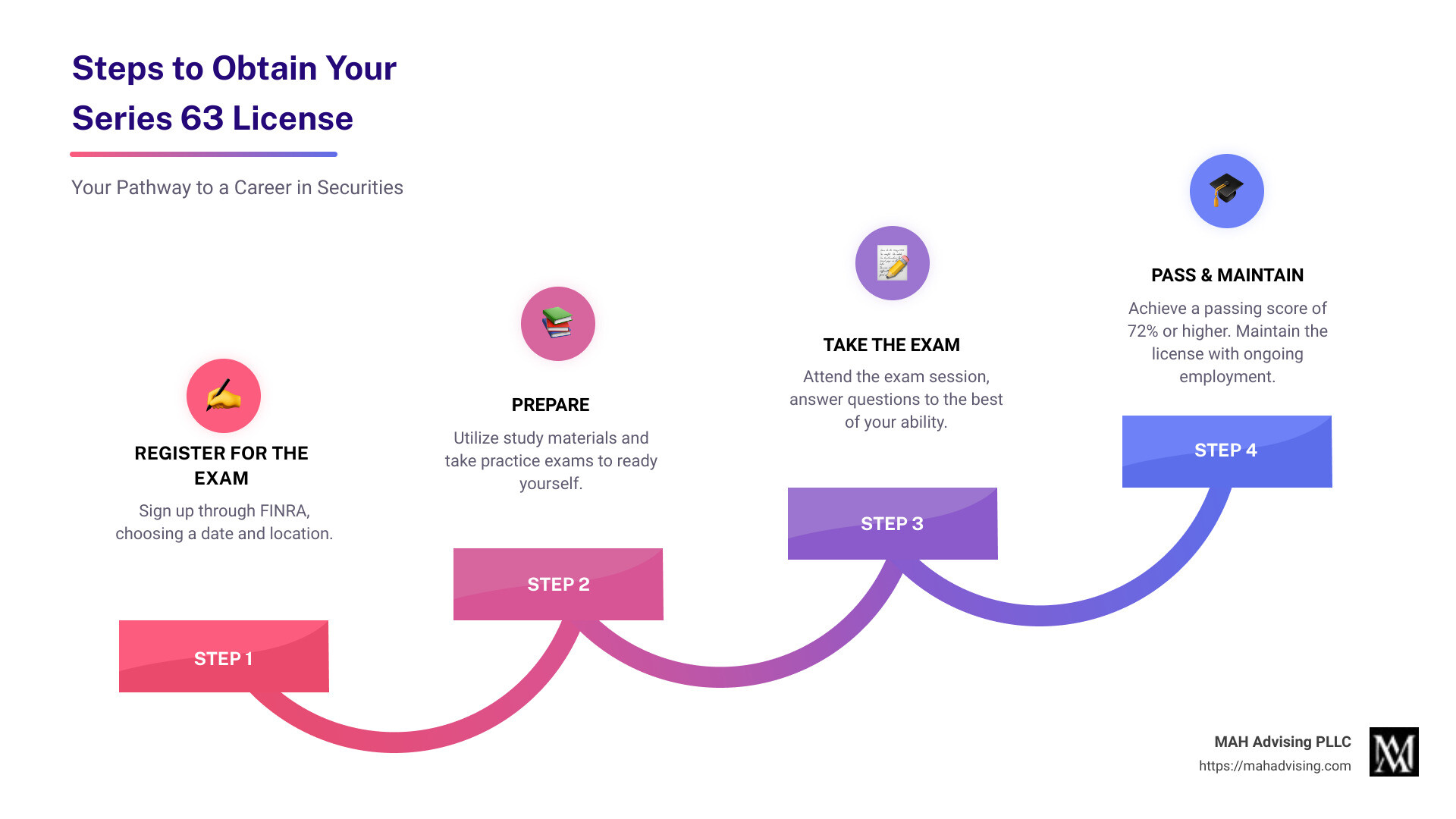
How to Obtain the Series 63 License
Obtaining the Series 63 license is an essential step for those looking to engage in the securities business at the state level. Here’s a simple guide on how to go about it.
Step 1: Understand the Series 63 License Requirements
Unlike some securities exams, you don’t need to be sponsored by a FINRA-member firm to take the Series 63 exam. This makes it somewhat unique, as it focuses on state law compliance rather than the broader scope of securities transactions.
Step 2: Prepare for the Securities Industry Essentials (SIE) Exam (Optional but Recommended)
While not a prerequisite for the Series 63, the Securities Industry Essentials (SIE) Exam provides foundational knowledge that can be beneficial. This exam covers basic securities industry information and concepts.
Step 3: Study for the Series 63 Exam
Dedicate time to study the materials related to the Uniform Securities Act and other regulations governing the securities business at the state level. You can find various resources, including online courses, textbooks, and practice exams, to help you prepare. Understanding ethical business practices and fiduciary responsibilities is also crucial.
Study Tips:
– Create a Study Plan: Allocate daily or weekly study times leading up to the exam.
– Practice Tests: Take full advantage of practice exams to familiarize yourself with the format and types of questions you’ll encounter.
– Focus on Key Areas: Make sure you understand the principles of state securities regulation, ethical practices, and fiduciary duties.
Step 4: Register for and Schedule Your Exam
Registration for the Series 63 exam is done through FINRA. You’ll schedule your exam through Prometric, which offers testing locations nationwide. Ensure you choose a date that gives you ample time to prepare.
Step 5: Pass the Exam
The Series 63 exam consists of multiple-choice questions that you must complete within the allotted time. Achieving a passing score is the final step in obtaining your Series 63 license.
Exam Day Tips:
– Arrive Early: Get to the testing center early to avoid any stress.
– Stay Calm: Keep a steady pace throughout the exam. If you’re unsure about a question, make your best guess and move on.
– Review Your Answers: If time allows, review your answers to ensure you didn’t miss anything due to misreading a question.
Once you’ve passed the exam, you’ll have met the requirements to transact securities business on behalf of a broker-dealer at the state level. While the Series 63 license is a significant achievement, it’s often just one part of the licensure needed to engage in various securities activities. Depending on your career goals, you may also need to obtain other licenses, such as the Series 6 or Series 7.
At MAH Advising PLLC, we understand the importance of navigating these regulatory requirements confidently. We’re here to offer guidance and support as you work towards achieving your professional goals in the financial industry.
Series 63 vs. Other Licensing Exams
When stepping into finance and securities, it’s crucial to understand the different licensing exams available besides the Series 63 license. Each of these licenses serves a unique purpose and qualifies you for various roles within the industry. Let’s break down the Series 63 in relation to the Series 6, Series 7, Series 65, and Series 66 exams.
Series 6 License
- Focus: This license is all about investment products like mutual funds, variable annuities, and insurance premiums.
- Requirement: Ideal for professionals aiming to sell specific investment products.
- Comparison: The Series 63, on the other hand, is needed to comply with state laws for securities transactions. It doesn’t authorize you to sell specific products.
Series 7 License
- Focus: The most comprehensive of all, covering the sale of all types of securities products, including stocks, bonds, and more.
- Requirement: This is for individuals looking to be full-service brokers or “general securities” representatives.
- Comparison: While Series 7 covers federal-level securities, Series 63 ensures you’re compliant at the state level.
Series 65 License
- Focus: Reserved for those who wish to act as investment advisers.
- Requirement: It’s a must-have for anyone providing financial advice or managing client investment accounts.
- Comparison: Unlike the Series 63, which qualifies you to conduct securities business at the state level, Series 65 is all about investment advisory services.
Series 66 License
- Focus: Combines parts of the Series 63 and Series 65 exams, meant for investment adviser representatives.
- Requirement: Ideal if you’re looking to be both a securities agent and an investment adviser.
- Comparison: It’s a two-for-one deal, essentially covering the state law aspects of Series 63 and the advisory aspects of Series 65.
Investment Products vs. Securities Business
- Investment Products: Series 6 and Series 7 focus on selling investment products directly.
- Securities Business: Series 63, 65, and 66 are more about the regulations surrounding the sale of these products and providing advice.
At MAH Advising PLLC, we guide our clients through understanding these differences clearly. Knowing which licenses align with your professional aspirations helps in tailoring your career path efficiently. Whether you’re aiming to sell specific financial products or provide expert investment advice, understanding the scope and requirements of each license is key. We’re here to assist in navigating these complex waters, ensuring you’re well-prepared for the exams that match your career goals in the securities business.
Preparing for the Series 63 Exam
Preparing for the Series 63 exam is a crucial step on your path to becoming a licensed securities professional. This license opens up various opportunities, allowing you to solicit orders for any type of security in most states. Here’s how you can gear up for the exam with confidence.
Understand the Exam Structure
First things first, get familiar with what the Series 63 exam entails. The test consists of 60 multiple-choice questions, and you need to achieve a passing score of 72% or higher. You’ll have 75 minutes to complete the exam, so time management is essential. The cost to take the exam is $135.
Dive into the Exam Topics
The Series 63 exam covers a broad range of topics, including state securities regulations, ethical practices, fiduciary obligations, and the prohibition of dishonest or unethical practices. Roughly 45% of the questions deal with regulations, so make sure you have a solid understanding of the Uniform Securities Act and related policies.
Create a Study Plan
A well-structured study plan is crucial for exam success. Consider dedicating 30 to 40 hours of study time to fully grasp the material. Break down your study sessions into manageable chunks and focus on one topic at a time. Tailoring your study plan to your learning style can significantly enhance your retention of the material.
Use Practice Tests
Practice tests are an invaluable tool in your exam prep arsenal. They not only familiarize you with the question format and phrasing but also help identify areas where you need further review. Analyzing your practice test results allows you to fine-tune your study plan and focus on weaker areas.
Familiarize Yourself with Key Definitions
Given the exam’s focus on state securities regulations and ethical practices, it’s important to be well-versed in the definitions of terms like agents, broker-dealers, securities, and administrators. Understanding these concepts inside and out will help you navigate the exam questions more effectively.
Ethical Practices and Fiduciary Obligations
Ethical practices and fiduciary obligations are at the heart of the Series 63 exam. As you prepare, reflect on real-world scenarios where these principles come into play. This will not only help you answer exam questions but also prepare you for practical situations you’ll encounter as a licensed professional.
State Securities Acts
Lastly, a thorough understanding of State Securities Acts, commonly known as blue-sky laws, is essential. These laws vary from state to state, so make sure you’re familiar with the specifics of the states where you plan to practice.
At MAH Advising PLLC, we understand the challenges of preparing for regulatory exams like the Series 63. We’re here to support you every step of the way, from providing personalized tutoring to helping you develop a robust study plan. The key to success is a well-rounded preparation strategy that covers all exam topics, combined with a deep understanding of ethical and fiduciary obligations. With the right approach, you’ll be well on your way to achieving your Series 63 license and advancing your career in the financial services industry.
Jobs and Opportunities with a Series 63 License
Once you’ve navigated the challenging waters of the Series 63 exam and proudly hold your Series 63 license, a new horizon of career opportunities unfolds before you. This license, while not empowering you to engage in securities business on its own, plays a crucial role when combined with other necessary licenses like the Series 6 or Series 7. Here are some of the paths and opportunities that become accessible:
Financial Adviser
As a Financial Adviser, your role would be to guide clients through their investment choices, retirement planning, and overall financial strategies. Holding a Series 63 license signifies your understanding of state securities regulations, an essential component in providing well-rounded advice.
Insurance Agent
While primarily focused on insurance products, Insurance Agents often expand their offerings to include investment products. For this, a Series 63 license is invaluable, ensuring you’re compliant with state laws when discussing investment options with clients.
Stockbroker
Stockbrokers are in the business of buying and selling securities. To effectively operate across state lines and ensure compliance with state-specific securities regulations, the Series 63 license is a must. It complements the Series 7 license, allowing you to engage in a broader spectrum of securities transactions.
Brokerage Firms
Working within Brokerage Firms often requires a comprehensive understanding of various securities laws and regulations. The Series 63 license equips you with knowledge of state securities regulations, making you a valuable asset to any firm looking to ensure compliance across all operations.
Investment Firms
Investment Firms seek professionals who can navigate the complex landscape of securities regulations with ease. With a Series 63 license, you demonstrate your capability in this area, opening doors to roles in portfolio management, securities analysis, and client advisement.
Banks
Banks that offer investment products to their customers need professionals who are not only skilled in financial advisement but also versed in the legal requirements of securities transactions. Your Series 63 license assures that you can provide these services while adhering to state laws and regulations.
Transitioning to Our Expertise
At MAH Advising PLLC, we understand the intricacies of the financial industry and the critical importance of staying compliant with securities laws and regulations. Whether you’re embarking on a new career path with your Series 63 license or looking to navigate the complex regulatory landscape, we’re here to support your journey. Our expertise in securities law and dedication to our clients make us the ideal partner for financial professionals seeking to leverage their Series 63 license for career advancement.
The world of finance is vast, and the Series 63 license is a key that unlocks many doors. Whether you aim to advise clients on their financial futures, trade securities, or work within the structures of investment and brokerage firms, this license is a step toward fulfilling your professional goals. And we, at MAH Advising PLLC, are committed to guiding you through every step of your career in the financial industry.
Frequently Asked Questions about the Series 63 Exam
When stepping into the complex world of financial advising and securities selling, understanding the licensing requirements is crucial. The Series 63 license often comes up in discussions, and it’s natural to have questions about it. Here, we aim to clarify some of the most common inquiries we encounter.
What is the difference between Series 63 and Series 7?
The Series 63 and Series 7 licenses serve different purposes and are governed by different regulatory bodies. The Series 63 license, officially known as the Uniform Securities Agent State Law Examination, is primarily focused on state laws and regulations regarding the trading and selling of securities. It’s a requirement for those who wish to conduct securities business in most states.
On the other hand, the Series 7 license, or the General Securities Representative Exam, is a more comprehensive federal license that allows holders to sell a broad range of securities products, such as stocks, bonds, and mutual funds. It’s considered a prerequisite for many financial advising and stockbroking roles.
In short, while Series 7 covers federal-level securities, Series 63 ensures you’re compliant with individual state laws.
How long is the Series 63 license good for?
The Series 63 license does not have an expiration date as long as you remain employed with a FINRA-member firm or a self-regulatory organization. However, if you leave such employment and do not secure another position within two years at another FINRA-member firm or SRO, your Series 63 license will expire. This two-year grace period is crucial for those transitioning between jobs or taking a career break.
What does the Series 63 qualify you for?
With a Series 63 license, you’re qualified to act as a securities agent. This means you can sell and trade securities, such as stocks and bonds, on behalf of your clients within the state(s) where you are licensed. The Series 63 license is often a requirement for roles like financial advisers, brokers, and other positions within investment firms, brokerage houses, and banks. Essentially, it’s a key that unlocks the ability to engage in a wide range of securities transactions on a state level, complementing federal licenses like the Series 6 or Series 7 for a well-rounded securities profession.
In conclusion, whether you’re planning to advise clients on their financial futures, trade securities, or work within the structures of investment and brokerage firms, the Series 63 license is a critical step toward achieving your professional aspirations. At MAH Advising PLLC, we’re here to support you through each phase of your journey in the financial industry, providing tailored solutions and expert guidance to navigate the complexities of financial regulations and licensing.
Michael Hurckes: Transform Your Career with Series 63 License
Earning your Series 63 license paves the way for a rewarding career in the financial services industry. It’s more than just a certification; it’s a commitment to ethical practice, fiduciary responsibility, and a deep understanding of state securities regulations. This license opens doors to various roles within the financial sector, from advising clients on investment strategies to trading securities.
Career Advancement
Holding a Series 63 license signifies to employers and clients alike that you possess the knowledge and integrity to operate within the stringent framework of financial regulations. It’s a crucial credential for those looking to advance their careers in finance, providing a solid foundation for further professional development and specialization.
Financial Professional
As a financial professional, the Series 63 license equips you with the authority to guide clients through the complexities of investment options, while adhering to the highest standards of ethical conduct. Whether you’re advising on stocks, bonds, or mutual funds, this license ensures that you’re doing so with both expertise and integrity.
At MAH Advising PLLC, we understand the importance of this milestone in your career. We’re committed to providing you with the support and resources needed to navigate the regulatory landscape successfully. From preparing for the Series 63 exam to understanding the implications of your licensure, our team is here to help.
Embarking on the journey to obtain your Series 63 license is a significant step toward establishing yourself as a trusted financial advisor. We invite you to explore our regulatory exams services for more information on how we can assist you in achieving this goal. Together, we can unlock the potential for a prosperous career in the financial industry.
For further reading and to understand more about how we can support your career in the financial sector, please visit our services page.